COMMERCIAL ROOF INSPECTION
Commercial Drone & Infrared Roof Inspection Services
Identify thermal anomalies, investigate suspected moisture, and make better informed commercial roofing decisions using radiometric infrared imaging, high-resolution aerial photography and physical verification.

Serving commercial clients across Alabama, Georgia, Florida and expanding markets.
Aerial Inspection
High-resolution RGB and infrared imaging
Thermal Analysis
Radiometric long-wave (LWIR) infrared thermography
Moisture Investigation
Tramex DEC testing and physical verification
Actionable Reporting
Clear findings to support repair, restoration or replacement
Commercial roof problems are not always visible from the surface. RCRS uses high-resolution aerial imagery, infrared thermography and targeted moisture investigation to help building owners, facility managers and property professionals better understand the condition of commercial roofing systems before making major repair, restoration or replacement decisions.
Our objective is not simply to produce thermal images. We collect and interpret inspection data in the context of the roof assembly, environmental conditions and observable building conditions, then investigate significant findings further where appropriate. The result is a more complete body of information that can support practical roofing and capital-planning decisions.
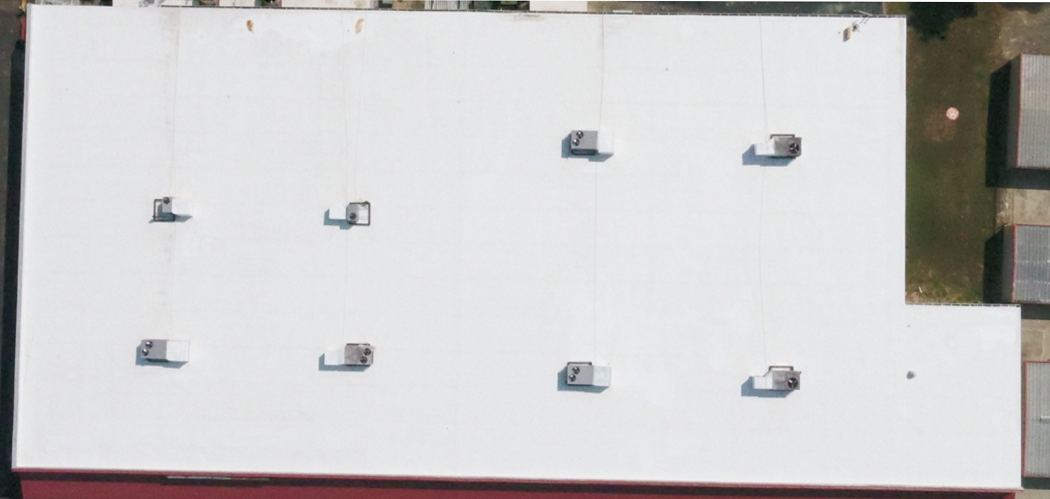
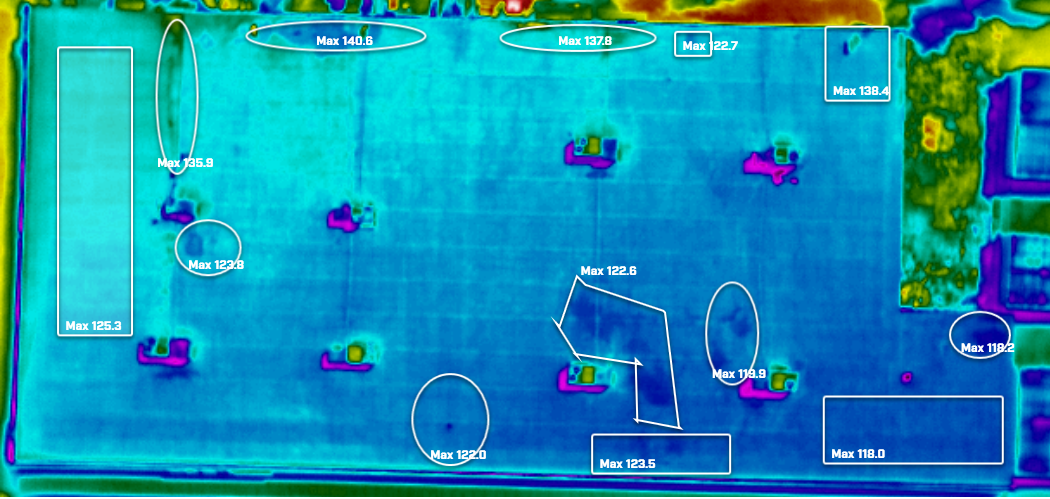
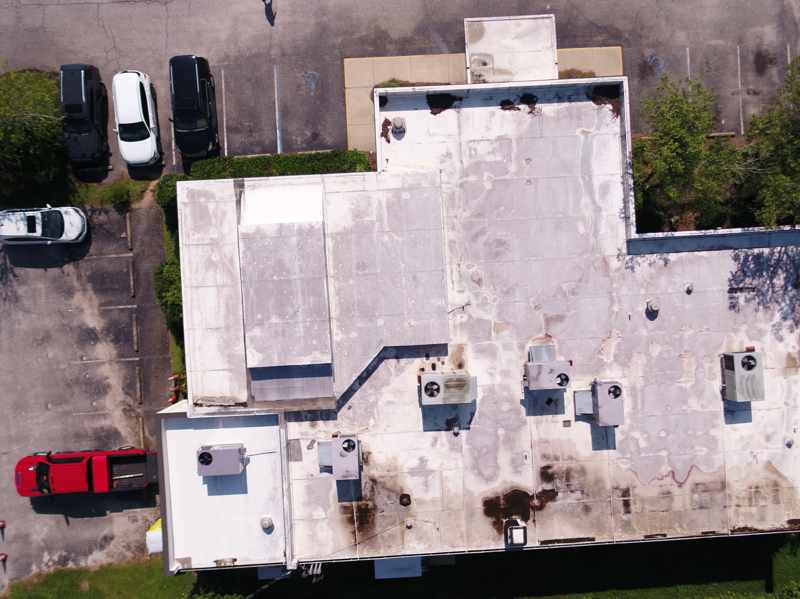
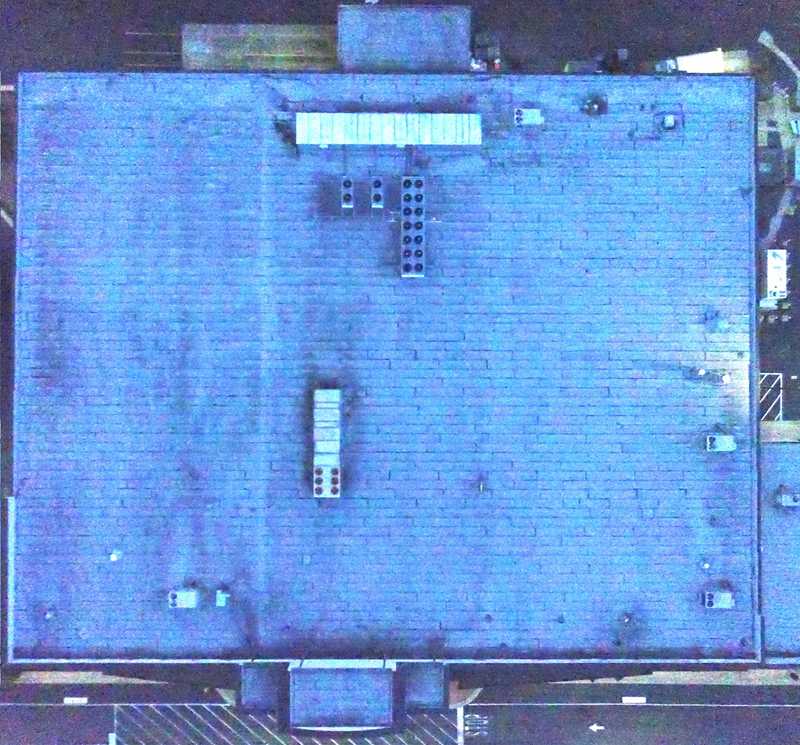
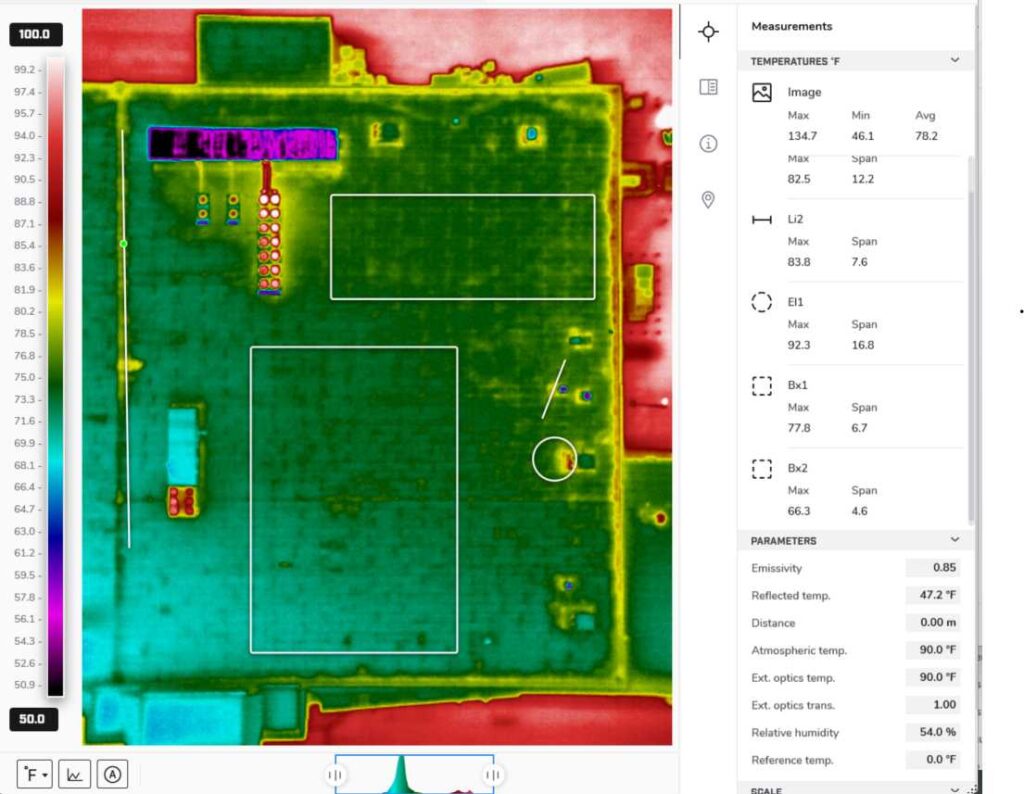
RGB and infrared views of the same commercial roof. Visible imagery documents physical roof conditions, while infrared imagery reveals thermal patterns that may warrant further investigation.
Thermal patterns are interpreted alongside roof construction, environmental conditions and physical moisture investigation where appropriate.
What Is a Commercial Drone & Infrared Roof Inspection?
The term drone roof inspection can describe anything from basic aerial photography to a structured thermographic investigation. Those services are not the same.
At RCRS, drone-based inspection can combine several complementary forms of information.
High-resolution visual inspection
RGB imagery provides a detailed aerial record of visible roof conditions. Depending on the inspection objective, this may include membrane condition, penetrations, drainage areas, transitions, previous repairs, rooftop equipment and other observable features.
Systematic aerial coverage also allows large commercial roof areas to be documented efficiently while providing context that can be difficult to obtain from isolated photographs taken at roof level.
Infrared thermography
Infrared imaging records differences in thermal energy emitted from the roof surface. Under suitable environmental conditions, those differences can reveal thermal patterns that warrant further investigation.
Moist and dry roofing materials can sometimes heat and cool differently because their thermal properties are different. The resulting patterns may help identify areas where additional moisture investigation is appropriate.
Infrared imaging does not allow an operator simply to “see water through the roof.” The information must be interpreted in relation to the roofing system, environmental conditions and corresponding visual evidence.

Physical moisture investigation
Where thermal findings warrant further investigation, RCRS can evaluate selected areas from the roof surface using non-destructive moisture-detection equipment such as the Tramex DEC.
When appropriate and authorized, physical investigation may also include core sampling to examine conditions within the roof assembly directly.
Each method answers a different question. Used together, they can provide a much stronger basis for understanding roof condition than relying on any one image, instrument or automated result.

The strongest conclusions come from correlation—not from any one inspection technology.
What Does Infrared Roof Thermography Actually Detect?
Infrared thermography measures patterns of surface temperature.
That distinction matters.
A commercial roof is made up of multiple materials that absorb, retain and release heat differently. Insulation containing moisture may behave thermally differently from surrounding dry insulation under appropriate conditions. As the roof heats and later cools, those differences can sometimes produce recognizable temperature patterns at the surface.
A trained thermographer evaluates those patterns rather than simply looking for the brightest or darkest area in an image.
The inspection may consider:
- the temperature difference, or Delta T, between a suspect area and its surroundings
- the shape and boundaries of the thermal pattern
- whether the pattern is consistent across multiple images
- its position within the roof system
- roofing materials and assembly type
- nearby penetrations, drainage features and rooftop equipment
- previous repairs or known roof conditions
- corresponding visible-light imagery
- weather and survey conditions
- results from subsequent physical moisture investigation.
This context is essential because roof surfaces can display temperature differences for many reasons other than trapped moisture.
A Thermal Anomaly Is Not Automatically Moisture
One of the most important principles in professional roof thermography is that a temperature anomaly is an observation, not a diagnosis.
Reflected heat, changing environmental conditions, differences in materials, drainage patterns, roof repairs, rooftop equipment and other physical features can all influence thermal imagery.
For that reason, RCRS does not classify every temperature difference as wet insulation.
Instead, thermal findings are evaluated alongside visible imagery, known roof construction, field conditions and—where warranted—on-roof moisture testing and physical verification.
A thermal anomaly is a reason to investigate—not a diagnosis by itself.
Thermal patterns become more useful when they are interpreted alongside visible roof conditions and physical investigation.
The RCRS Correlation & Verification Method
Reliable commercial roof diagnostics depend on more than collecting a thermal image.
RCRS uses a layered process designed to correlate information from multiple sources and progressively investigate areas of concern. The exact scope depends on the roof, inspection objective and field conditions, but the methodology can include the following stages.
1. Systematic Aerial Infrared Survey
The roof is surveyed using a planned flight intended to document the complete roofing system rather than only isolated problem areas.
Typical data collection can include nadir imagery across the building and roof, systematic thermal coverage, lower-altitude passes where greater spatial detail is required, and additional imagery around penetrations, rooftop equipment, drainage areas, transitions and other relevant features.
The objective is to create a coherent dataset that can be reviewed as a whole.
2. High-Resolution RGB Documentation
Visible-light imagery provides physical context for the thermal data.
A temperature pattern may become much easier to interpret once it is compared with the corresponding roof surface, penetration, drain, repair, mechanical unit or construction transition.
This RGB correlation is an important part of separating potentially meaningful thermal patterns from conditions that can be explained visually.
3. Thermal Analysis
RCRS evaluates more than the colors displayed in a thermal palette.
The analysis can consider Delta T, high- and low-temperature areas, anomaly geometry, boundaries, repeatability, position within the roof assembly and the relationship between the thermal pattern and surrounding conditions.
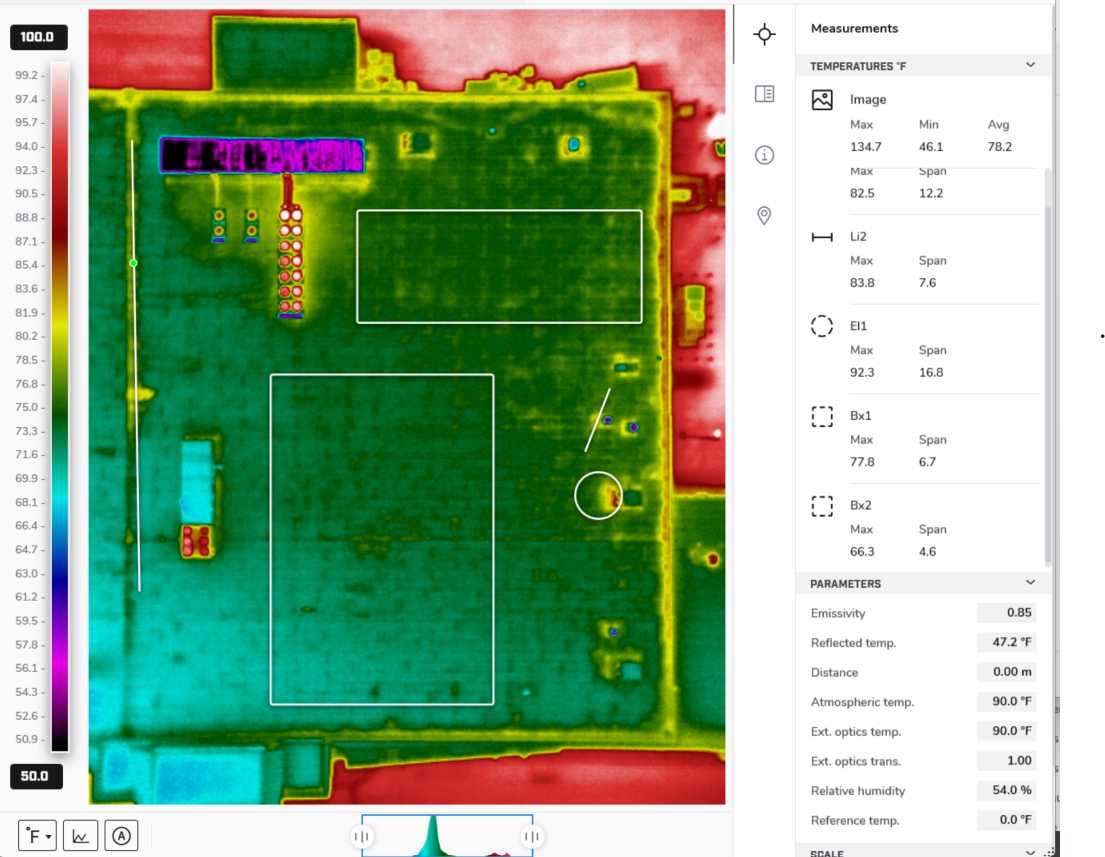
FLIR analysis software allows temperature information to be examined using points, lines, areas and polygons so that suspect regions can be compared with surrounding reference areas.
The resulting thermal pattern is then considered alongside the roof construction, environmental conditions and visible imagery.
4. Targeted On-Roof Moisture Investigation
Where a thermal anomaly warrants further investigation, RCRS can evaluate the area physically using Tramex DEC non-destructive moisture-detection equipment.
Readings from suspect areas can be compared with known or reference areas of the roof. Instrument sensitivity can be adjusted as the team evaluates the strength and approximate extent of the response.
This allows the aerial findings to guide a more focused roof-surface investigation rather than testing the roof blindly.
6. Professional Roofing Interpretation
The final objective is not to determine whether a thermal image looks unusual.
It is to understand what the combined evidence means for the roof.
RCRS can use the findings from aerial thermography, RGB imagery, moisture investigation and physical verification to help inform decisions involving:
repair, targeted wet-insulation removal, roof restoration, maintenance planning, sectional replacement, complete replacement and longer-term capital planning.
This is where roofing experience matters. The inspection data becomes useful when it can be translated into an appropriate next step for the building.
Aerial infrared data → RGB correlation → thermal analysis → moisture investigation → physical verification where appropriate → roofing decision

What Makes a Commercial Infrared Roof Inspection Reliable?
A reliable infrared roof inspection depends on much more than flying a thermal camera over a building.
The quality of the final information depends on the complete inspection process: the capability of the equipment, environmental conditions during data collection, flight methodology, understanding of the roofing assembly, interpretation of the thermal patterns and appropriate verification of significant findings.
A high-quality thermal camera can collect useful data, but equipment alone cannot determine what a temperature pattern means.
Reliable Results Begin With Reliable Data
Professional roof thermography requires sufficient thermal detail to distinguish meaningful patterns across a commercial roof.
The imaging system must capture enough spatial and temperature information for the thermographer to evaluate differences between suspect areas and their surroundings. Radiometric capability is particularly important because it allows temperature information within the thermal image to be analyzed after the flight rather than relying only on the appearance of a color palette.
Flight altitude, optics, image coverage and platform stability also affect the level of roof detail represented in the collected data.
The objective is not simply to obtain a recognizable picture of the building. It is to collect a dataset suitable for analysis.
Environmental Conditions Matter
Even excellent equipment can produce inconclusive information when a survey is performed under unsuitable conditions.
Infrared roof thermography relies on differences in the way roofing materials heat and cool. Recent rainfall, insufficient solar loading, cloud cover, wind, roof construction and the timing of the survey can all influence the thermal patterns that develop.
For this reason, RCRS evaluates survey conditions before relying on the resulting data and may postpone an inspection when conditions are unlikely to produce meaningful thermal contrast.
We cover the environmental requirements and survey timing in greater detail in our guide to when commercial infrared roof surveys should be performed.
Interpretation Requires More Than Software
Thermal-analysis software can measure temperatures, compare selected areas and help identify patterns within large datasets.
It cannot, by itself, determine why a pattern exists.
Software can organize data, calculate temperatures and help identify patterns. It does not replace engineering and roofing judgment when determining whether those patterns are meaningful.
A thermographer must consider the roofing system, insulation, deck construction, previous repairs, drainage, penetrations, reflected energy, weather conditions and corresponding visible imagery before determining whether a thermal anomaly warrants further investigation.
This is one reason practical roofing and building-envelope experience matters alongside thermography training.
Verification Strengthens the Conclusion
When the purpose of an inspection is to investigate possible moisture within a roofing system, RCRS does not rely on infrared imagery alone.
Significant thermal findings can be compared with visible-light imagery and investigated physically using methods such as Tramex DEC moisture testing and, when appropriate and authorized, core verification.
Each stage contributes a different form of evidence.
Professional equipment cannot compensate for poor methodology or interpretation—but inadequate equipment can limit the quality of the data from the outset.
Professional Drone & Thermal Imaging Equipment
The rapid growth of drone technology has made thermal cameras available at many different price and performance levels.
That accessibility has advantages, but the presence of a thermal sensor does not automatically make a drone suitable for professional commercial roof thermography.
For RCRS, the equipment is selected as part of a complete inspection system. Thermal resolution, radiometric capability, optics, visible-light image quality, aircraft stability and analysis software all contribute to the usefulness of the collected information.
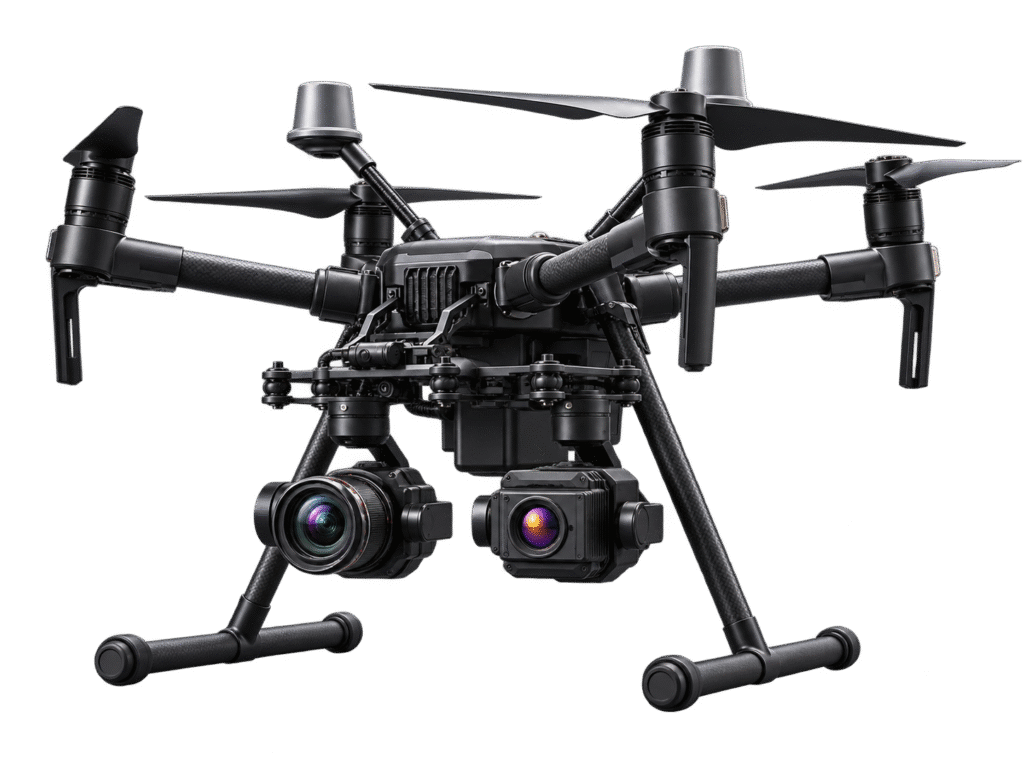
The RCRS Inspection Platform
RCRS invests approximately $40,000 in each set of drone, thermal imaging and associated inspection equipment.
The current aerial inspection platform includes:
- DJI Matrice 210 V2 professional UAS platform
- Radiometric DJI/FLIR Zenmuse XT V2.0 thermal camera — 640 × 512 resolution, 30 Hz, 13 mm lens
- DJI Zenmuse X5S visual camera — 20.8 MP Micro Four Thirds sensor with 15 mm f/1.7 lens
- FLIR thermal analysis and reporting software
- supporting flight, data-management and field-inspection equipment
The Matrice 210 V2 supports both the Zenmuse XT-R and X5S payload families. The X5S uses a 20.8-megapixel Micro Four Thirds sensor, and DJI lists the 15 mm f/1.7 lens used by RCRS among its supported configurations.
The Zenmuse XT-R platform uses an uncooled long-wave infrared detector. DJI specifies 640 × 512 configurations at a full frame rate of 30 Hz and a spectral range of 7.5–13.5 μm.
What Does 640 × 512 Radiometric Thermal Imaging Mean?
A 640 × 512 thermal image contains 327,680 thermal pixels per frame.
That provides substantially more spatial information than a low-resolution thermal image when surveying large roof areas or examining smaller patterns within a commercial roofing system.
Just as importantly, RCRS uses a radiometric thermal camera.
Radiometric imagery preserves temperature-measurement information within the thermal dataset so that the thermographer can analyze temperatures and temperature differences after the flight. Instead of simply viewing a red, yellow or blue pattern, the image can be examined using measurement points, lines, areas and polygons within the analysis software.
This enables RCRS to evaluate Delta T, compare suspect areas with surrounding reference areas and examine the geometry and consistency of thermal patterns.
The 30 Hz specification describes how frequently the full thermal image can be refreshed during operation. It contributes to a smooth live thermal view and data-acquisition workflow, but frame rate alone does not determine the accuracy or reliability of a roof survey.
Why the 13 mm Thermal Lens Matters
Thermal resolution must always be considered together with the optics and the distance between the camera and the roof.
The 13 mm lens fitted to the RCRS thermal system determines the camera’s field of view and, together with flight altitude and sensor resolution, affects how much roof area is represented by each thermal pixel.
This is why professional flight planning is important. Flying higher may provide broader coverage, while lower-altitude passes can provide greater spatial detail where the inspection requires it.
RCRS can therefore document the complete roof systematically while collecting additional lower-altitude imagery around suspect areas or important roof features.
High-Resolution RGB Imagery Provides Context
Thermal information becomes considerably more useful when it can be compared with high-quality visible imagery.
RCRS uses a Zenmuse X5S with a 15 mm f/1.7 lens for RGB documentation. DJI specifies the X5S at 20.8 effective megapixels and a 5280 × 3956 maximum still-image resolution in its 4:3 format.
That visible imagery helps the thermographer relate a temperature pattern to the actual roof.
A thermal anomaly may coincide with a penetration, drain, previous repair, transition, HVAC unit, change in roofing material or another physical feature that helps explain what is being observed.
This is why RCRS treats RGB and infrared imaging as complementary datasets rather than independent inspections.
Equipment quality affects the data that can be collected. Professional interpretation determines whether that data can support a roofing decision.
Why Invest Approximately $40,000 in an Inspection System?
The cost of the equipment is not, by itself, evidence that an inspection is reliable.
A poorly planned survey performed with expensive equipment can still produce poor information.
The significance of the investment is the capability it provides: professional aircraft, high-resolution radiometric thermal capture, high-resolution visible imagery, appropriate optics, analysis software and supporting equipment designed for a professional inspection workflow.
At the other end of the market, lower-cost thermal systems may have considerably less thermal resolution, reduced measurement capability or other limitations that affect the amount of usable information collected from a large commercial roof.
The question for a building owner or property manager should therefore not simply be:
“Does the contractor have a thermal drone?”
A better question is:
“What data does the inspection system collect, how is that data analyzed, and how are the findings verified?”
That is the standard RCRS applies to its own inspection methodology.
The camera collects the data. The inspection process determines whether the data is useful.
Who Interprets the Data Matters as Much as the Equipment
High-quality thermal equipment is only part of a professional roof investigation. The value of the data ultimately depends on who interprets it, what information they have about the roof assembly, and how the findings are correlated with conditions observed in the field.
Some drone-inspection workflows separate data collection from interpretation. Images may be captured by one operator and later reviewed by a third-party analyst who was not involved in the roof investigation and may have limited information about the building, roofing system or physical conditions observed on site.
RCRS takes a different approach.
Our thermal and inspection data is interpreted by our engineer in the context of the complete project. That review can incorporate the roof construction, visible-light imagery, thermal patterns, Delta T, known repairs, drainage, penetrations, rooftop equipment, moisture-testing results and other field information collected during the investigation.
A thermal image does not make the decision. The quality of the interpretation determines whether the image becomes useful roofing information.
Keeping Interpretation Connected to the Roof
Separating image capture from roof knowledge can make it easier to mistake an unusual thermal pattern for trapped moisture or overlook conditions that are important to the roofing decision.
RCRS evaluates thermal findings as part of a broader diagnostic process rather than as isolated images. Where warranted, aerial findings can be compared with RGB imagery, Tramex moisture investigation, physical observations and core verification.
This gives the engineer a more complete body of evidence to work from when helping determine what the findings may mean for repair, restoration, replacement or capital planning.
The objective is not simply to have someone read the thermal image. It is to have someone understand what the image means in the context of the roof.
When Should an Infrared Roof Survey Be Performed?
The quality of an infrared roof survey depends not only on the equipment being used, but also on when the data is collected and the environmental conditions at the time of the inspection.
Infrared thermography relies on measurable temperature differences across the roof surface. Roofing materials containing moisture can absorb, retain and release heat differently from surrounding dry materials, but those differences must be allowed to develop before they can be evaluated effectively.
For this reason, RCRS considers recent weather, solar loading, roof dryness, wind, cloud conditions, roof construction and the thermal behavior of the building when planning an infrared survey.
The objective is not simply to fly at a convenient time. It is to collect thermal data when the roof is capable of producing useful information.
Why the Roof Should Be Dry Before the Survey
Recent rainfall can complicate the interpretation of a thermal roof survey.
Surface moisture, ponding water and recently wetted materials can create thermal patterns that may obscure or interfere with the temperature differences the inspection is intended to evaluate.
As a general RCRS field guideline, the roof should preferably have experienced approximately three days of dry weather before the infrared survey, although the appropriate period can vary according to the roof assembly, weather conditions and inspection objective.
The roof surface itself should be dry when the survey is performed.
This is one reason weather monitoring is part of the inspection process rather than something considered only immediately before the drone is launched.
Solar Loading Helps Create Thermal Contrast
During the day, solar radiation heats the roofing system.
Different roof materials—and materials in different moisture conditions—may absorb and store that energy differently. As environmental conditions change later in the day, those differences can become visible as thermal patterns at the roof surface.
When evaluating conditions for thermographic work, RCRS considers the amount of solar loading the roof has received. Under suitable conditions, approximately 800–1,000 W/m² of solar irradiance can provide useful loading for the inspection methodology.
That figure should not be treated as a universal threshold for every roof. Roof construction, insulation, membrane type, weather and the thermal behavior of the building all influence the conditions required to produce useful contrast.
Suggested media: a daylight image of a commercial roof with a small caption explaining that solar loading is part of the thermal cycle being evaluated.
Why Infrared Roof Surveys Are Often Performed After Sunset
For many commercial roofing systems, one of the most useful inspection periods occurs after the sun has stopped heating the roof.
As the roof begins to cool, areas with different thermal properties may release stored heat at different rates. Under appropriate conditions, this can make potentially significant thermal patterns easier to distinguish.
RCRS nighttime surveys are commonly performed approximately two to four hours after sunset, depending on the roof assembly, preceding weather and the way the building and roof are responding thermally.
The correct time is therefore not simply a fixed number of minutes after sunset.
The thermographer must consider whether the necessary thermal contrast has actually developed.
Sunset starts the cooling process. It does not automatically create an inspection window.
I like that as a callout because it corrects the oversimplified “always scan X hours after sunset” advice that appears on a lot of websites.
Wind, Clouds and Changing Weather Can Affect the Results
Thermography is sensitive to environmental conditions.
Strong wind can accelerate surface cooling. Changing cloud cover can alter solar loading. Recent rain or surface moisture can introduce additional thermal effects. Different roof assemblies may also respond at different rates.
For this reason, a survey that would work well on one evening may produce less useful information under different conditions.
RCRS evaluates the conditions surrounding the survey rather than relying solely on a scheduled flight time.
Sometimes the correct decision is to wait
If conditions are unlikely to produce meaningful thermal information, postponing the survey may be more appropriate than collecting a weak dataset and trying to draw conclusions from it.
That is an important point to make commercially:
A professional infrared inspection sometimes begins with deciding not to fly.
I would put that in a shaded callout.
It reinforces everything we’ve been saying about methodology over convenience.
ASTM C1153 and Commercial Infrared Roof Surveys
ASTM C1153 provides a recognized practice for using infrared imaging to locate areas of wet insulation in qualifying roofing systems.
The current ASTM C1153-23 specifically applies to nighttime infrared inspection of roofing systems with insulation above the roof deck and in contact with the waterproofing. It covers both aerial and ground-based surveys.
The standard addresses several of the factors that influence a professional survey, including:
- infrared equipment criteria
- meteorological conditions
- differences in roof construction and materials
- roof conditions
- operating procedures
- operator qualifications and practices and
- verification of infrared findings using invasive testing methods.
This reinforces an important principle of the RCRS methodology:
Infrared thermography is a process governed by equipment, conditions, interpretation and verification—not simply the production of thermal images.

What ASTM C1153 Does Not Tell You
Understanding the limitations of the method is just as important as understanding its capabilities.
ASTM C1153 specifically states that the practice does not determine the cause of moisture or its point of entry. It also does not determine whether a particular roofing system remains suitable to function as waterproofing.
In practical terms, identifying an area associated with suspected wet insulation does not automatically answer:
- where the water entered
- why it entered
- whether the membrane needs repair
- whether the roof should be restored
- whether part of the roof should be replaced or
- whether complete replacement is warranted.
Those questions require the infrared findings to be considered alongside the physical roof condition, moisture investigation and broader roofing assessment.
Infrared can help locate the problem area. Roofing investigation determines what should be done about it.
Even when an infrared survey is performed under suitable conditions, the resulting thermal patterns remain part of an investigation rather than the end of it. When an area warrants further evaluation, RCRS can move from aerial thermography to targeted on-roof moisture investigation.
How RCRS Investigates and Verifies Potential Roof Moisture
An infrared roof survey can identify areas that behave differently from the surrounding roof, but the thermal image is only one layer of evidence.
When a thermal pattern warrants further investigation, RCRS can move from remote sensing to targeted on-roof testing. The objective is to determine whether the observed thermal response is consistent with conditions within the roof assembly and to establish the approximate extent of the affected area before a roofing decision is made.
This layered approach helps reduce the risk of treating every thermal anomaly as trapped moisture.
Infrared narrows the search. Physical investigation tests the hypothesis.
Tramex DEC Non-Destructive Moisture Investigation
RCRS uses Tramex DEC electrical-impedance moisture-detection equipment to investigate selected areas from the roof surface.
The instrument does not simply produce a universal “moisture percentage.” Instead, the roof is evaluated comparatively. Readings from suspect areas can be compared with areas believed to represent relatively dry reference conditions, allowing the team to identify changes in the instrument response across the roofing system.
Depending on the investigation, RCRS may begin at a higher sensitivity and progressively adjust the instrument as the team evaluates the strength and approximate boundaries of the response.
This makes the Tramex survey especially useful after infrared thermography. Rather than surveying without direction, the aerial thermal findings can help focus physical investigation on areas that already warrant closer attention.
ASTM D7954/D7954M describes the use of non-destructive electrical-impedance scanners for locating moisture and evaluating comparative moisture content in suitable low-slope roofing and waterproofing systems. The standard also recognizes both systematic continuous scanning and grid-based survey techniques.
Establishing Reference Conditions
Comparative moisture investigation depends on understanding how the scanner responds to the particular roof being tested.
Where a known dry area is available, it can be used as a reference. If one is not known initially, the instrument can be moved across the roof to identify areas producing the lowest relative response and establish a practical baseline for comparison.
Tramex’s own published survey procedure recommends calibrating the scanner against an area where the roof surface, insulation and underlying components are dry before conducting the broader survey.
This is another reason RCRS does not treat one isolated electronic reading as a diagnosis. The significance lies in the pattern and comparison across the roof.
Mapping the Approximate Extent of the Response
Once an area produces an elevated response, the team can continue testing around it to determine how far that response appears to extend.
The result can be incorporated into a moisture map showing areas that warrant additional investigation or consideration during repair, restoration or replacement planning.
This does not mean the boundary should be interpreted as a perfectly precise line between “wet” and “dry.” Roofing assemblies are complex, and instrument response can be affected by construction, materials and other conditions.
The purpose of mapping is to develop a better picture of where the concern appears to be concentrated and how extensive it may be.
Thermal findings can guide targeted on-roof moisture investigation, allowing suspect areas to be evaluated in greater detail.
Why Roof Construction Matters to Moisture Testing
Electrical-impedance scanning is useful, but it is not appropriate for every roofing material or assembly.
ASTM D7954 notes that conductive materials can interfere with impedance-based testing. Its published scope specifically identifies metal and certain other conductive components as unsuitable and also cautions against applications such as black EPDM or aluminum-faced materials where false-positive responses can occur.
That makes knowledge of the roof assembly important before the data is interpreted.
The question is not merely:
“Did the moisture scanner respond?”
It is:
“Does that response make sense for this roof construction, this location and the other evidence available?”
This mirrors the same principle used in infrared thermography: instruments provide measurements; professional interpretation determines their significance.
Core Verification When Appropriate
In some investigations, non-destructive methods provide enough information to guide the next step. In others, direct physical verification is warranted.
When appropriate and authorized, RCRS can take a core sample from a selected area of the roof.
A core allows the roof assembly to be examined physically and can provide direct evidence about conditions within the membrane, insulation and other roof components at that location.
ASTM D7954 specifically addresses invasive verification of impedance findings using core samples, reinforcing the role of physical confirmation within a structured moisture investigation.
The decision to take a core depends on the roof, the findings and the decision that needs to be made.
The objective is not to perform invasive testing unnecessarily. It is to use the appropriate level of verification for the significance of the conclusion being drawn.
The greater the consequence of the roofing decision, the stronger the evidence should be behind it.
Multiple Methods Provide Stronger Evidence
The strength of the RCRS approach comes from combining different forms of information rather than asking one technology to answer every question.
A typical investigation may progress through:
Aerial infrared survey → RGB correlation → thermal analysis → Tramex DEC investigation → moisture mapping → core verification where appropriate → roofing interpretation
Each stage can either reinforce the working hypothesis or provide evidence that the initial thermal pattern has another explanation.
That distinction is important.
A professional inspection should be capable not only of finding evidence that supports a concern, but also of recognizing when the evidence does not support the original assumption.
Turning Moisture Findings Into a Roofing Decision
Moisture investigation becomes commercially valuable when the findings can be translated into an appropriate roofing scope.
Depending on the results, the information may support targeted repair, removal and replacement of affected insulation, restoration of suitable roof areas, sectional replacement, complete replacement, maintenance planning or future capital budgeting.
The purpose is not to automatically recommend the largest project.
It is to understand the condition of the roof well enough to make the scope defensible.


The goal is not to prove the thermal image right. The goal is to determine what is actually happening in the roof.
What Does a Professional Commercial Roof Inspection Report Include?
A commercial roof inspection is only as useful as the information that can be carried forward from it.
The final report should do more than present a collection of thermal images. It should provide a clear record of what was inspected, how the inspection was performed, what conditions were observed, which findings require attention, how those findings were verified, and what next steps may be appropriate.
For building owners, facility managers and property-management teams, that documentation can become part of the longer-term history of the roof rather than a one-time snapshot.
The goal is not simply to document that an inspection took place. It is to create information that can still support a roofing decision months or years later.
Inspection Scope and Property Information
A professional report should clearly identify the building and the purpose of the inspection.
Depending on the project, this may include:
- property and building identification;
- inspection date and time;
- areas of the roof included in the survey;
- known roof-system information;
- reason for the inspection;
- specific areas of concern identified by the client;
- and any relevant limitations on access or survey coverage.
This creates context for everything that follows.
A report prepared to investigate a recurring leak, for example, may be interpreted differently from a portfolio-condition survey or an inspection performed before a major restoration project.
Environmental and Survey Conditions
Because infrared thermography is affected by environmental conditions, the report should preserve relevant information about the circumstances under which the data was collected.
Depending on the inspection, this may include:
- recent precipitation;
- roof-surface condition;
- ambient conditions;
- solar loading;
- approximate survey timing relative to sunset;
- wind and cloud conditions;
- and other factors that may have influenced the thermal response.
Documenting those conditions helps another professional understand the basis on which the thermal findings were interpreted.
It also becomes particularly useful when inspections are repeated over time.
RGB and Infrared Imagery
Visible and thermal imagery should be presented as complementary information.
High-resolution RGB images provide recognizable physical context: roof penetrations, drains, HVAC equipment, previous repairs, membrane transitions and other visible conditions.
Thermal imagery documents temperature patterns that may warrant additional investigation.
Where possible, corresponding thermal and visual images can be presented together so that the reader can understand where a thermal anomaly occurs in relation to the physical roof.
This is much more useful than presenting isolated thermal images without context.
Mapped Areas of Concern
For larger commercial roofs, individual photographs can be difficult to interpret without knowing where they were taken.
A professional report can therefore include roof plans, aerial maps or annotated imagery identifying the location and approximate extent of significant findings.
Potentially relevant information may include:
- thermal anomalies;
- areas producing elevated Tramex responses;
- visible membrane damage;
- drainage concerns;
- previous repairs;
- wet-insulation investigation areas;
- core locations;
- and recommended follow-up areas.
This allows somebody reviewing the report later to connect a finding with a specific location on the roof.
Good inspection documentation answers both “what did you find?” and “where exactly should we look?”
Verification Status Should Be Clear
Not every finding carries the same level of certainty.
For that reason, RCRS believes a report should distinguish between different stages of investigation rather than presenting every observation as a confirmed condition.
For example, a finding might be described as:
Thermal anomaly observed
A temperature pattern warrants further investigation.
Thermal and moisture response correlated
The thermal finding corresponds with an elevated response during physical moisture investigation.
Physically verified
A core or other direct investigation has provided supporting physical evidence.
This distinction is especially important when reports are later reviewed by property managers, consultants, roofing manufacturers, insurers or other parties who were not present during the original inspection.
It prevents a preliminary observation from gradually becoming treated as a confirmed fact simply because it appears in a report.
Limitations Are Part of a Professional Report
A good inspection report should also explain what the investigation cannot establish.
Depending on the scope, relevant limitations may include:
- areas that could not be surveyed;
- roof assemblies unsuitable for a particular test method;
- environmental conditions affecting interpretation;
- conductive materials affecting moisture-scanner response;
- thermal anomalies that were not physically verified;
- and the distinction between locating suspected moisture and determining the source of water entry.
Including limitations does not weaken the report.
It makes the conclusions easier to understand and more defensible.
A useful report should make clear both what the evidence supports and where additional investigation may still be required.
From Inspection Findings to Recommended Next Steps
The report should ultimately help answer the practical question:
What should happen next?
Depending on the scope and findings, recommendations may include:
- targeted repair investigation;
- additional moisture testing;
- core verification;
- removal of wet insulation;
- preventative maintenance;
- restoration evaluation;
- sectional replacement;
- full roof replacement planning;
- drainage or building-envelope investigation;
- or continued monitoring.
The recommendation should follow from the evidence rather than being predetermined before the inspection begins.
This is particularly important for RCRS because the company can connect diagnostic information directly to real commercial roofing decisions.
Reports as Part of Long-Term Roof Asset Management
For property owners managing one major facility—or dozens of properties—the value of inspection documentation increases over time.
A properly organized report can provide a baseline against which future inspections can be compared.
That can help answer questions such as:
- Has a known area of concern expanded?
- Is a previous repair performing as expected?
- Has a storm introduced new conditions?
- Is moisture becoming more widespread?
- Which buildings within a portfolio require attention first?
- Can a capital project reasonably be deferred?
- Which roofs should be inspected again next year?
This is where repeatable drone imagery, thermal data and structured reporting become much more than a one-time inspection service.
They begin to form part of a roof asset-management record.
Pre-Event and Post-Event Documentation
For facilities exposed to severe weather, a documented roof condition can also provide a useful baseline before and after a major event.
Aerial imagery can help record visible roof conditions, while subsequent inspections can document changes that may warrant further investigation.
This type of documentation can support discussions among owners, property managers, roofing consultants, contractors and insurance professionals.
I would deliberately avoid promising that a report will “prove an insurance claim” or guarantee coverage.
The stronger and more defensible proposition is:
Consistent documentation gives stakeholders better evidence with which to evaluate what changed and what requires attention.
An inspection report should preserve the reasoning behind the roofing decision—not just the photographs that were taken.
AI and Software in Commercial Roof Inspection
Drone inspection generates information quickly.
A single commercial-roof survey may produce hundreds or thousands of visible and thermal images, temperature measurements, mapped locations, field observations and supporting records. Across multiple buildings or a large property portfolio, the volume of information can become substantial.
Software already plays an important role in organizing, analysing and reporting that data. Artificial intelligence is increasingly adding another layer by helping identify patterns, compare large datasets and prioritize information for professional review.
RCRS views these technologies as tools that can strengthen a well-designed inspection process—not substitutes for the inspection process itself.
AI can help find patterns in the data. It does not determine whether those patterns make physical sense.
How RCRS Uses Thermal Analysis Software Today
RCRS currently uses FLIR thermal-analysis and reporting software to examine radiometric imagery collected during infrared roof surveys.
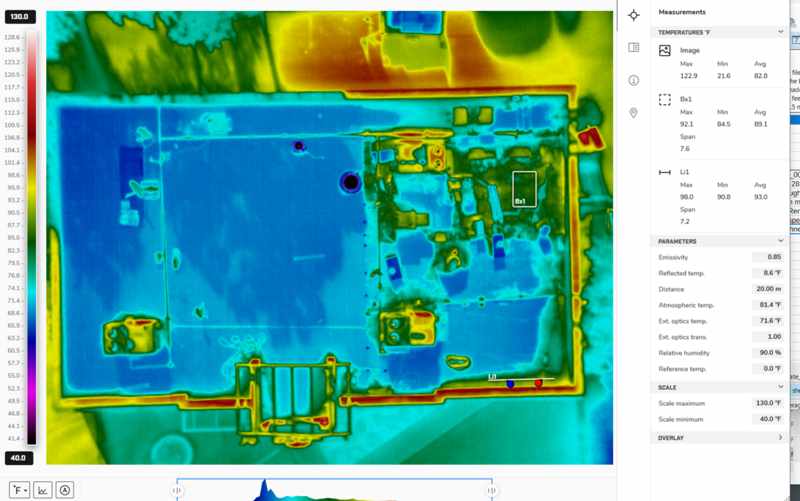
Rather than evaluating a thermal image solely by its visible colour palette, the thermographer can use measurement tools to examine:
- individual temperature points;
- lines across areas of interest;
- defined measurement areas and polygons;
- high- and low-temperature readings;
- and temperature differences between suspect and surrounding areas.
Those measurements can then be compared with corresponding RGB imagery, known roof construction and physical conditions observed during the inspection.
Current FLIR Thermal Studio software is designed to manage and analyse large collections of radiometric thermal images and supports measurement, batch processing and professional reporting. FLIR specifically positions the platform for managing thousands of thermal images and videos from sources including unmanned aircraft systems.
The important distinction is that the software assists the thermographer in interrogating the data.
It does not remove the need to understand what produced the thermal pattern.

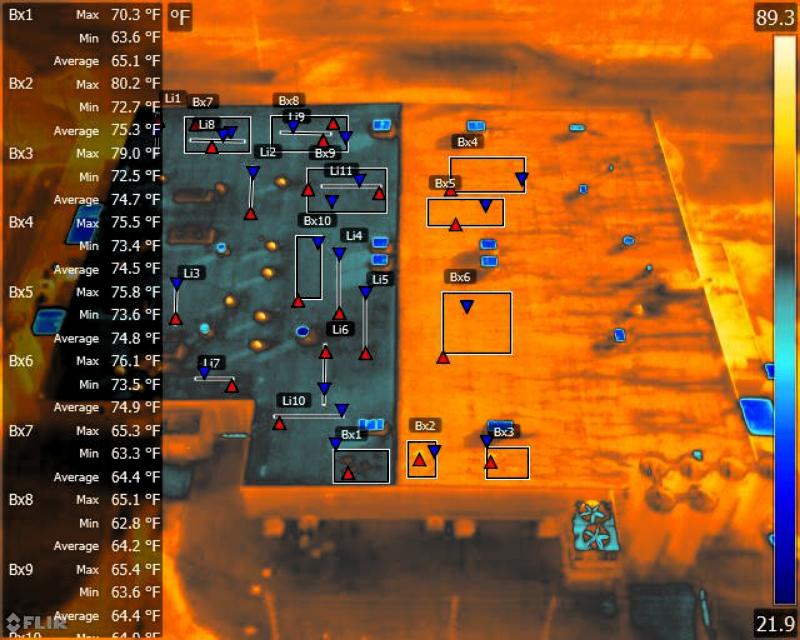
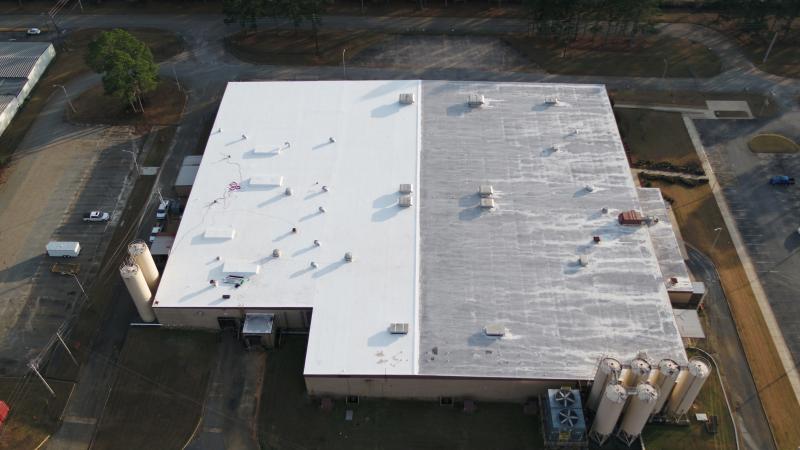
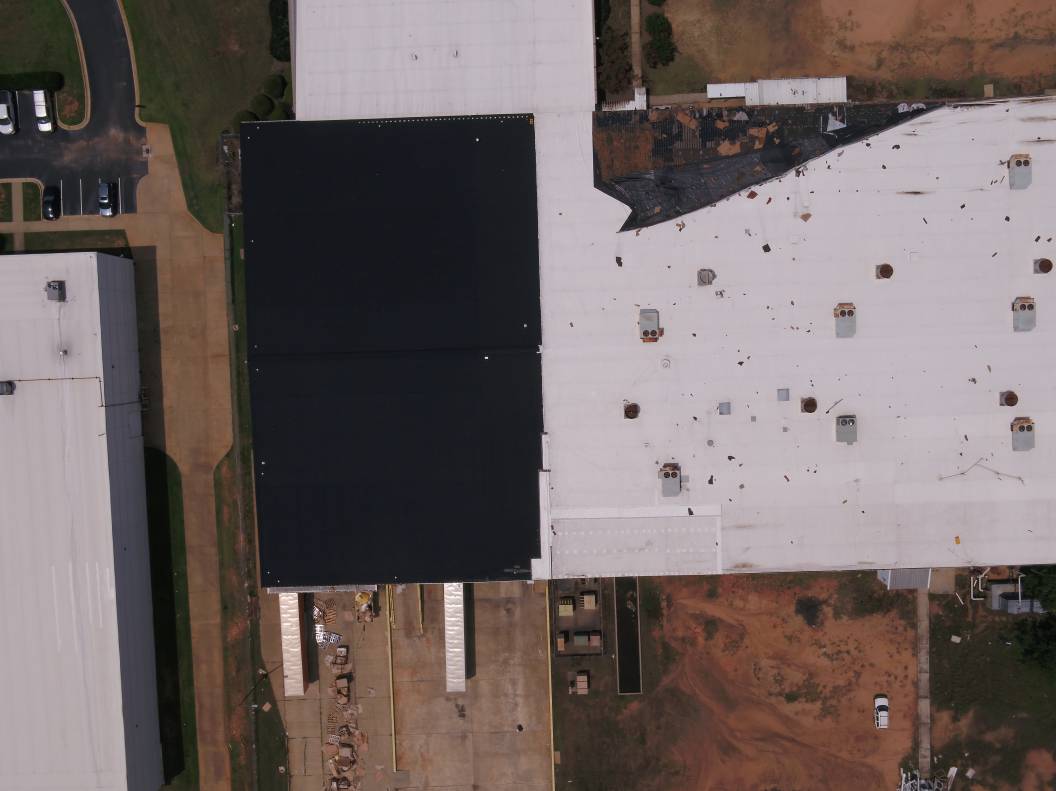
FLIR analysis of two commercial roofs in Tallahassee FL and Dothan AL
Software Can Help Organize Complex Inspection Data
As inspection projects become larger, software becomes increasingly useful for bringing different forms of information together.
Depending on the platform and inspection scope, software can assist with:
- systematic flight planning;
- image organization and geolocation;
- radiometric temperature analysis;
- orthomosaic and roof-map creation;
- identifying and marking areas of interest;
- comparing RGB and thermal imagery;
- measurement and area calculations;
- report production;
- historical inspection records;
- and comparisons between repeated surveys.
Commercial mapping platforms already support workflows of this kind. For example, DroneDeploy currently offers radiometric thermal processing and a dedicated thermal roof-inspection workflow, including support for DJI M200/210 aircraft and FLIR XT/XT2 sensors. Its guidance also emphasizes sufficient image overlap and notes that temperature-measurement quality ultimately depends on the sensor used to collect the data.
That last point is especially important:
Software cannot create information that was never captured by the inspection equipment.
Poor source data does not become reliable merely because sophisticated software is used to process it.
Where Artificial Intelligence Can Help
Artificial intelligence is particularly useful when the amount of inspection data becomes too large for efficient manual organization alone.
Potential applications include identifying recurring image patterns, grouping similar observations, prioritizing areas for review, comparing temperature ranges, organizing imagery by building or roof area, detecting changes between repeat inspections and helping generate consistent reports.
For a single commercial building, those capabilities may primarily improve efficiency.
For a multi-state roof portfolio, the potential becomes much greater.
An organization responsible for dozens or hundreds of commercial roofs may eventually accumulate:
thousands of roof areas → repeated annual inspections → large RGB datasets → thermal datasets → moisture findings → repair histories → storm records → capital-planning information.
AI can help make that information searchable and comparable.
The important opportunity is therefore not simply:
“Can AI find a roof problem?”
A more useful question is:
“Can AI help a facilities team understand which roofs across an entire portfolio require human attention first?”
That is where we believe the technology may become particularly valuable.
AI and Repeat Roof Inspections
One of the most promising applications is comparison over time.
If a roof has been documented consistently during successive inspections, software can potentially assist in identifying:
- new areas of concern;
- changes in previously documented anomalies;
- expansion or contraction of mapped areas;
- changes following repair work;
- storm-related differences;
- and roofs whose condition appears to be changing faster than others within the portfolio.
This creates the possibility of moving from isolated inspection reports toward a longitudinal roof-condition record.
For property managers and facilities teams, that can support more informed maintenance and capital planning.
Instead of treating every roof as an emergency when a problem becomes visible inside the building, historical inspection data can help identify where intervention may be required earlier.
What AI Cannot Reliably Replace
RCRS does not believe an automated result should automatically be treated as scientific confirmation.
Roof thermography requires context.
A temperature difference may be influenced by roof construction, insulation type, deck materials, reflected energy, drainage, repairs, rooftop equipment, weather, solar loading or other environmental conditions.
An AI system analysing imagery may identify that a pattern is unusual.
A qualified thermographer still needs to ask:
Why is it unusual?
Does the pattern correspond with the roof construction?
Does it make sense in the environmental conditions under which the survey was performed?
Is there a corresponding visible condition?
Does Tramex testing support the interpretation?
Is physical verification warranted?
Could the apparent anomaly have another explanation?
Those questions involve building science, commercial roofing knowledge, thermography experience and field evidence.
Pattern recognition and professional interpretation are not the same thing.
AI Depends on the Quality of the Underlying Data
AI systems are ultimately dependent on the data and assumptions on which they operate.
If the source imagery is poor, environmental conditions are unsuitable, important roof-construction information is missing or the original interpretation is wrong, automated analysis can reproduce or amplify those problems.
This is particularly important in infrared roof inspection because seemingly similar temperature patterns can have different physical causes.
For RCRS, the priority therefore remains:
appropriate equipment → suitable survey conditions → systematic data collection → qualified interpretation → physical verification where appropriate.
AI can operate on top of that process.
It should not replace it.
An inspection report should preserve the reasoning behind the roofing decision—not just the photographs that were taken.
The Future of AI in Multi-Site Roof Management
As commercial-roof maintenance becomes more portfolio-based, the value of structured inspection data increases dramatically.
A facilities team responsible for buildings across several states may need to answer questions such as:
- Which roofs require immediate intervention?
- Which roofs should be investigated again?
- Which known areas are changing?
- Where are maintenance costs increasing?
- Which assets are approaching major capital expenditure?
- Which roofs have recently been affected by severe weather?
- Which buildings can safely remain in a maintenance program rather than move into replacement?
Traditionally, much of that information may be scattered across PDFs, photographs, spreadsheets, invoices and individual employees’ knowledge.
A more structured inspection system creates the possibility of combining those records into a searchable roof-asset dataset.
AI could then assist with triage, comparison and prioritization, while roofing professionals remain responsible for interpreting the findings and determining the appropriate response.
This may become particularly valuable as RCRS supports larger multi-state maintenance programs.
The future is not AI versus experience. It is AI helping experienced people work effectively across much larger datasets.
Human Judgment Remains Part of the Process
RCRS‘s current methodology already illustrates why human judgment remains important.
Infrared data is compared with visible imagery.
Thermal patterns are assessed in the context of roof construction and environmental conditions.
Suspected areas can be investigated using Tramex moisture-detection equipment.
Core verification can be used where appropriate.
The resulting information is then interpreted in relation to the actual roofing decision.
AI may increasingly assist at several points within that workflow, but the underlying principle remains the same:
Better technology is most useful when it supports better professional judgment.
Technology can reduce the time required to collect, organize and review roof-condition information, but professional drone inspection also introduces operational responsibilities of its own. Flights must be planned around people, structures, airspace, weather and other site hazards.
Drone Inspection, Roof Access & Operational Safety
Commercial drone roof inspection can reduce the amount of initial roof access required to document large or difficult-to-reach areas, but it does not eliminate the need for professional safety planning.
A commercial inspection may involve aircraft operations, occupied properties, parking areas, pedestrians, rooftop equipment, restricted access, weather, nearby airports and—when physical verification is required—personnel working directly on the roof.
For RCRS, drone operations and on-roof investigation are therefore treated as related but distinct parts of the inspection process.
The drone can reduce exposure to some hazards. It does not remove the responsibility to plan the operation safely.
Drones Can Reduce — But Not Eliminate — Roof Access
One advantage of aerial inspection is the ability to document large roof areas without requiring an inspector to physically walk every portion of the roof simply to collect photographs.
Nadir imagery, detailed visual photography and thermal data can be gathered efficiently from the air, allowing areas that warrant closer investigation to be identified before personnel are sent onto the roof.
That can be especially useful around large commercial buildings, difficult transitions, expansive roof systems and facilities where unnecessary access would disrupt operations.
However, the RCRS methodology does not assume that aerial inspection replaces physical investigation.
If a thermal anomaly requires moisture testing, a core sample is warranted, membrane conditions need to be examined closely or a repair condition must be evaluated directly, qualified personnel may still need to access the roof.
The objective is to use each method where it provides the most useful information.
Commercial Drone Operations and FAA Part 107
Commercial drone operations in the United States are generally conducted under the FAA‘s Small UAS Rule, 14 CFR Part 107.
Under Part 107, the remote pilot in command must hold an FAA Remote Pilot Certificate and maintain the required aeronautical knowledge currency. The aircraft must also be properly registered, and drones that are required to be registered generally must comply with FAA Remote ID requirements.
Part 107 also establishes operational requirements involving matters such as visual line of sight, airspace, altitude, people, moving vehicles and other flight conditions.
For a commercial roof inspection, this means flight planning begins before the aircraft reaches the property.
RCRS considers the proposed flight area, surrounding structures, airspace, property activity, environmental conditions and the inspection objective when determining how aerial data should be collected.
Professional drone inspection is an aviation operation as well as a roofing inspection.
Controlled Airspace and Properties Near Airports
Being located near an airport does not necessarily mean that a commercial roof cannot be inspected by drone.
What matters is the airspace in which the operation will occur and the restrictions applicable to that location.
The FAA permits Part 107 operations in Class G airspace without prior air-traffic-control authorization. Operations in controlled Class B, C, D and certain Class E airspace require authorization. The FAA’s Low Altitude Authorization and Notification Capability, or LAANC, can provide near-real-time authorization for many qualifying operations in controlled airspace below approved altitude limits.
Other locations or more complex operations may require additional coordination or authorization through FAA systems.
This becomes particularly relevant for facilities near airports, military installations and other controlled or restricted areas.
For RCRS, the airspace evaluation is therefore part of determining whether the proposed inspection can be performed, when it can be performed and what operational limitations may apply.
Nighttime Infrared Surveys Require Additional Planning
As discussed earlier, some infrared roof surveys are most useful after sunset when thermal differences within the roofing system have had an opportunity to develop.
That does not mean nighttime drone operation is automatically prohibited.
Current Part 107 rules allow routine nighttime operations without a special night waiver when the applicable requirements are met. FAA guidance requires the remote pilot to satisfy the relevant Part 107 training requirements and the aircraft to use anti-collision lighting visible for at least three statute miles. Controlled-airspace authorization is still required where applicable.
Night inspection therefore requires both:
appropriate thermographic conditions and appropriate aviation conditions.
A roof may be thermally ready for inspection while weather, airspace, site activity or another operational factor makes the flight unsuitable.
That is another reason survey timing cannot be determined solely by looking at the sunset time.
Occupied Commercial Properties Require Site Planning
Many commercial roof inspections occur while the building remains fully operational.
Employees may be arriving and leaving. Customers may be entering the property. Delivery vehicles may be moving through the site. Contractors may be working nearby. Mechanical equipment may be operating on the roof.
Those conditions affect how an inspection is planned.
FAA rules place specific restrictions on operations over people and moving vehicles, with permitted operations depending on the aircraft, operating category and circumstances.
Rather than assuming that the aircraft can simply be flown wherever the inspection requires, the flight plan should take the activity around the building into account.
A commercial inspection plan may therefore consider one or more of the following factors: launch and recovery location; pedestrian and vehicle activity; building entrances; adjacent properties; rooftop obstructions; power lines; HVAC equipment; visual-line-of-sight requirements; emergency landing options; and coordination with facility personnel.
This is particularly important at healthcare facilities, retail properties, industrial plants and other continuously occupied buildings.
Drone Safety and Roofing Safety Are Different Problems
A safe drone operation does not automatically make the on-roof portion of the inspection safe.
Once personnel access a commercial roof, the work introduces a different set of hazards involving roof edges, openings, ladders, access points, fragile surfaces, weather, equipment and the condition of the roof itself.
OSHA‘s construction fall-protection requirements include specific protections for employees exposed to unprotected roof edges and other fall hazards during roofing work.
That distinction matters because RCRS may intentionally use aerial inspection to reduce unnecessary roof exposure while still performing targeted physical investigation when the evidence warrants it.
A typical sequence might therefore be:
collect remotely → identify areas of concern → plan safe roof access → investigate only where necessary.
That is a much better operational story than implying that drones eliminate the need to go onto roofs altogether.
Safety Starts With the Inspection Plan
A technically successful inspection requires more than getting the aircraft into the air.
Before data collection begins, the team must consider whether the proposed operation can be performed safely and whether the conditions will allow the inspection objective to be achieved.
For RCRS, that means combining aviation planning with roofing judgment.
If the weather is unsuitable, the airspace cannot be accessed, pedestrian activity creates an unnecessary risk, thermal conditions are poor or physical roof conditions make investigation unsafe, the correct decision may be to modify or postpone part of the inspection.
Collecting the data is never more important than controlling the risks required to collect it.
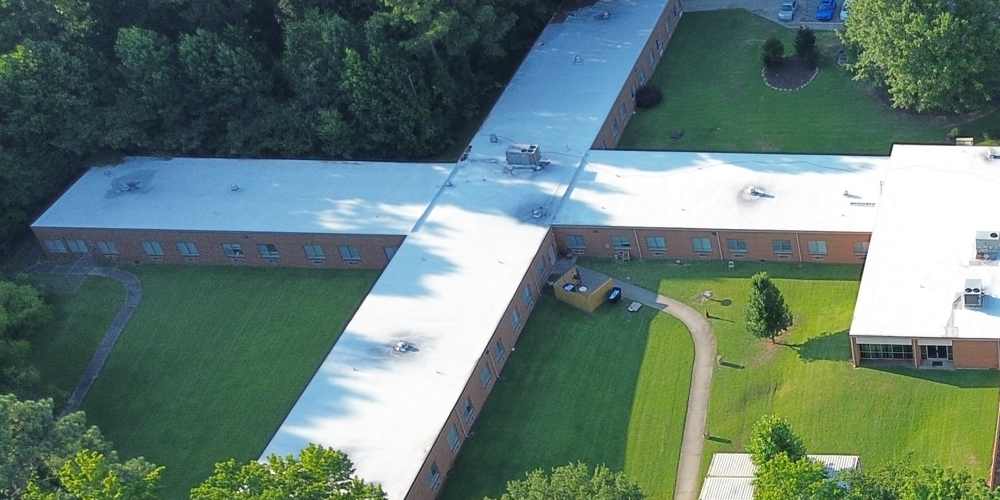
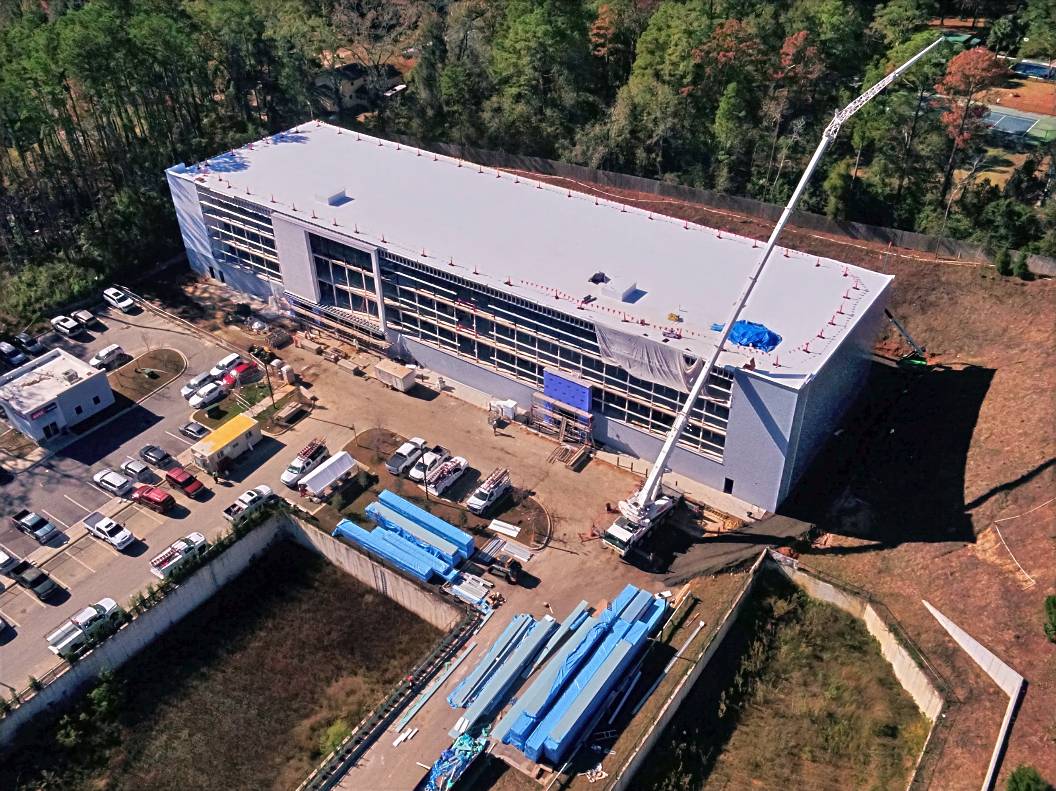
Drone technology can make commercial roof inspection more efficient and reduce unnecessary access, but equipment, qualified operation, analysis and physical verification all contribute to the cost of a professional inspection. The appropriate scope depends on the size of the property, the type of data required and the decision the inspection needs to support.
Questions to Ask Before Hiring a Drone Roof Inspection Provider
Commercial drone and infrared roof inspections can vary significantly in equipment, methodology, interpretation and verification. Before selecting a provider, building owners and property managers may want to understand how the inspection data will actually be collected and evaluated.
- What thermal camera and resolution will be used?
- Is the thermal imagery radiometric?
- Who will interpret the thermal data?
- What engineering, roofing and thermography experience does that person have?
- Will the person interpreting the data have access to the field observations and information about the roof assembly?
- How will thermal anomalies be correlated with visible-light imagery and roof conditions?
- How are significant findings verified?
- Will moisture meters, physical investigation or core verification be used where appropriate?
- Does the final report distinguish observations from confirmed findings?
The question is not simply whether a provider owns a thermal drone. It is whether the inspection process can turn the data into reliable roofing information.
How Much Does a Commercial Drone & Infrared Roof Inspection Cost?
The cost of a commercial drone roof inspection depends heavily on what the inspection is expected to accomplish.
A short aerial photography flight is fundamentally different from a radiometric infrared survey that requires specific environmental conditions, thermal analysis, on-roof moisture testing, mapping and physical verification.
For general budgeting, published U.S. commercial inspection pricing ranges from several hundred dollars for relatively straightforward commercial inspections into several thousand dollars for more extensive radiometric thermal surveys. One commercial thermography provider publishes a typical range of approximately $600–$3,500 for complete commercial radiometric roof surveys, while commercial building-inspection pricing also increases significantly with roof area and moisture-testing requirements.
Those figures are useful for context, but they should not be treated as an RCRS quote or a universal price per roof.
The meaningful question is not simply “What does a drone flight cost?” It is “What information does the inspection need to produce?”
Basic Aerial Inspection and Infrared Investigation Are Different Services
A basic drone roof inspection may primarily involve high-resolution visible photography.
That can be valuable when the objective is to document observable roof conditions, inspect difficult-to-see areas or establish a photographic record.
A thermographic investigation adds another level of complexity.
Depending on the scope, it may require:
planned daytime observations → appropriate solar loading → nighttime data collection → radiometric thermal imagery → RGB correlation → thermal analysis → on-roof moisture investigation → mapping → physical verification → reporting
The price reflects the amount of field work, equipment, analysis and professional interpretation required—not simply how long the aircraft remains in the air.
What Affects the Cost of a Commercial Roof Inspection?
Several factors can materially change the scope and cost.
Roof Size
A 10,000-square-foot commercial roof and a 300,000-square-foot distribution facility require very different amounts of flight coverage, imagery, processing and analysis.
Larger roofs generally create more data and more potential areas requiring review.
Number of Buildings
A self-storage complex, industrial campus, healthcare network or multi-building property may require separate flight plans and datasets for each structure.
Multiple buildings at one location can sometimes be inspected more efficiently than the same buildings spread across different locations, but the amount of data still increases.
Inspection Objective
The scope changes considerably depending on whether the client needs:
- general roof-condition documentation;
- storm-damage documentation;
- infrared moisture investigation;
- leak investigation;
- restoration planning;
- replacement planning;
- due diligence;
- warranty or maintenance documentation;
- or portfolio-level condition assessment.
The inspection should be designed around the decision being made.
Thermal Imaging Adds More Than a Different Camera
Professional infrared inspection involves more than attaching a thermal sensor to a drone.
RCRS uses a radiometric 640 × 512 thermal imaging system as part of an inspection platform representing approximately $40,000 in equipment plus supporting technology.
More importantly, thermographic work requires the survey to be performed under conditions capable of producing useful thermal information.
That may involve monitoring weather, evaluating roof dryness and solar loading, returning to the property after sunset, collecting additional thermal passes and analysing radiometric data after the flight.
The added cost therefore reflects both specialized equipment and a more demanding inspection methodology.
Thermal inspection is not simply an upgrade in camera quality. It is a different investigation process.
Moisture Testing and Physical Verification Affect the Scope
If the objective is to investigate possible moisture within the roofing system, aerial data may only be the first stage.
The inspection can expand to include:
- Tramex DEC testing;
- comparative moisture readings;
- establishing reference areas;
- mapping the approximate extent of responses;
- additional roof-surface investigation;
- core sampling where warranted and authorized;
- and interpretation of the combined findings.
A roof requiring several hours of targeted physical verification therefore cannot reasonably be priced the same as an aerial photo survey.
This is why two contractors can both advertise a “drone roof inspection” while quoting very different prices.
They may not actually be offering the same service.
Reporting Depth Also Changes the Cost
Deliverables matter.
At the simplest level, a client may only require organized photographs.
A more comprehensive inspection may require:
annotated RGB imagery | thermal imagery | mapped findings | moisture-test results | core locations | observations | limitations | recommended next steps
Producing that information requires additional review and reporting time after the field inspection is complete.
For property managers and facility teams, that reporting may ultimately be more valuable than the flight itself because it creates a record that can be referenced during budgeting, maintenance and future inspections.
Airspace, Travel and Site Conditions Can Affect Pricing
Some properties are straightforward to inspect.
Others require additional planning because of controlled airspace, nearby airports, occupied areas, security procedures, difficult access or operational restrictions.
Travel also becomes relevant when a project is located outside RCRS’s normal service areas or when multiple site visits are required for daytime and nighttime data collection.
Properties with unusual operational requirements should therefore be scoped before a firm inspection price is established.
What Are You Actually Paying For?

Aerial Visual Inspection
High-resolution RGB documentation of visible roof conditions.Best suited for: General condition documentation, storm observations, maintenance records and hard-to-access areas.
Infrared Roof Survey
Systematic RGB and radiometric thermal data collection under appropriate environmental conditions.Best suited for: identifying thermal patterns that may warrant additional investigation.
.
Infrared + Moisture Investigation
Thermography combined with targeted Tramex DEC testing and moisture mapping.Best suited for: roofing decisions where understanding the approximate extent of suspected moisture is important.
Comprehensive Diagnostic Investigations
Aerial inspection, moisture investigation, mapping and physical verification such as core sampling where appropriate.Best suited for: Repair/restoration/replacement planning and higher-consequence capital decisions.
RCRS scopes the inspection around the question the building owner needs answered rather than automatically applying the most extensive testing to every property.
When Can an Inspection Save Money?
The economic value of an inspection is not necessarily found in reducing the inspection fee.
It is found in improving the roofing decision that follows.
A relatively small investment in diagnostics may become significant when it helps determine whether a building requires:
- A localized repair instead of broad replacement
- Sectional replacement instead of full replacement
- Wet-insulation removal before restoration
- Continued maintenance instead of immediate capital expenditure
- Replacement where continued repairs no longer make economic sense
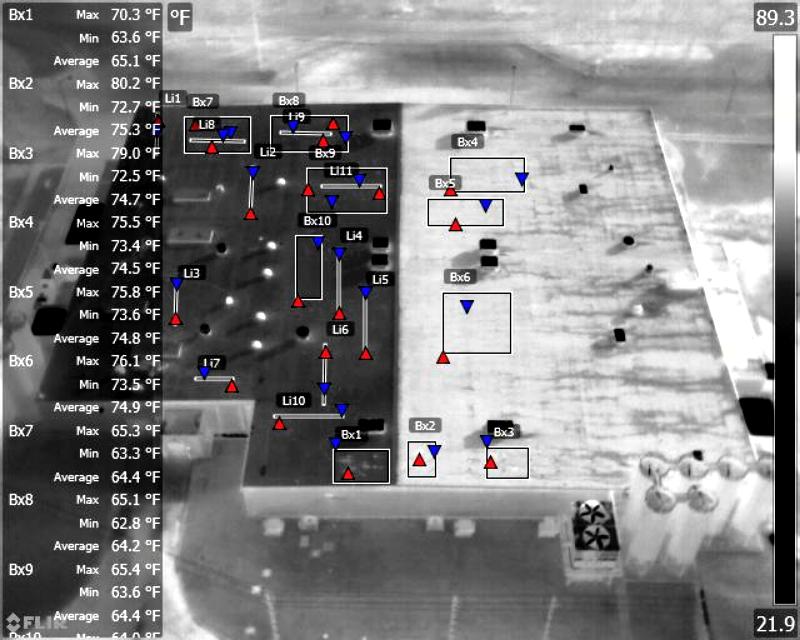
The cost of good diagnostic information should be considered in relation to the cost of the roofing decision it supports.
Why RCRS Does Not Publish One Flat Inspection Price
Commercial buildings vary too much for one flat rate to describe every inspection honestly.
A small single-building visual survey, a 200,000-square-foot infrared investigation and a ten-building moisture-mapping project should not carry the same scope or pricing model.
Before pricing an inspection, RCRS typically needs to understand:
- property location;
- approximate roof area;
- number of buildings;
- roofing system where known;
- inspection objective;
- whether thermal imaging is required;
- whether on-roof moisture investigation is anticipated;
- reporting requirements;
- and any unusual site or airspace conditions.
From there, the inspection can be scoped around the information required.
Tell us the property location, approximate roof size and what you are trying to determine. We can recommend an appropriate inspection scope before pricing the project.
When Should a Commercial Roof Be Inspected?
Commercial roof inspection is most valuable when it is tied to a specific decision.
Sometimes that decision is immediate: a building is leaking, a storm has passed through, or a contractor needs to determine the appropriate repair scope.
In other cases, the objective is preventive: establish a baseline, evaluate a roof before restoration, plan future capital expenditure, document conditions before a warranty period expires, or compare multiple roofs across a property portfolio.
The appropriate inspection method depends on the question being asked.
The best time to understand a commercial roof is usually before the only remaining question is how quickly it must be replaced.
When a Roof Is Leaking but the Source Is Unclear
Interior water intrusion does not always identify where moisture entered the roofing system.
Water can travel through insulation, deck interfaces, structural components and other parts of the assembly before it becomes visible inside the building.
A roof inspection can help document surface conditions and narrow the investigation.
Where appropriate, aerial imagery, infrared thermography and targeted moisture testing can be combined with physical roof investigation to evaluate whether the visible leak is part of a localized condition or evidence of a broader problem.
The objective is not simply to find the wet ceiling tile.
It is to understand what is happening within the roofing system well enough to determine the appropriate next step.
Before Roof Restoration or Coating
A roof that looks suitable for restoration from the surface may still contain moisture beneath the membrane.
That matters because restoration systems are generally intended to extend the service life of a roof that remains a viable candidate for restoration—not to conceal widespread moisture or deteriorated components.
Before a major coating or restoration project, inspection can help identify areas requiring further investigation, wet-insulation removal or localized replacement.
This can allow the restoration scope to be developed around the actual condition of the roof rather than assuming the entire assembly is uniform.
A restoration decision should be based on what is beneath the membrane as well as what can be seen from above it.
Before Committing to Complete Roof Replacement
A roof may have recurring leaks, isolated damaged areas or significant visible deterioration without every part of the roofing system being in the same condition.
Diagnostic inspection can help establish whether the evidence supports localized repair, sectional replacement or a larger capital project.
It cannot guarantee that full replacement will be avoided, nor should that be the objective of every inspection.
The purpose is to understand whether the proposed scope is consistent with the condition of the roofing system.
Your Dothan medical-products facility is already a strong example of this principle, so I would not repeat the whole story here.

Before replacement of the existing low-slope roofing system at Enterprise City Hall, RCRS performed a comprehensive infrared thermography investigation to evaluate conditions within the roof assembly. The survey identified thermal patterns consistent with widespread moisture intrusion across multiple roof sections. In this case, the inspection did not support continued localized repair as the most appropriate long-term strategy; the extent of the findings helped support planning for complete roof replacement.
Periodic inspection is valuable not only when it helps extend roof life, but also when it provides the evidence needed to recognize that a roof has reached the point where continued repair is no longer the appropriate strategy.
After Hail, High Wind or Severe Weather
Storm damage is not always obvious from the ground.
After a significant weather event, aerial documentation can help establish the visible condition of large roof areas, rooftop equipment, penetrations, edges and other relevant features.
Where there is reason to suspect damage below the surface, additional investigation may be warranted.
The value of post-storm inspection increases when good pre-event documentation already exists.
That allows the owner or property manager to compare conditions rather than relying entirely on memory or isolated photographs taken after the event.
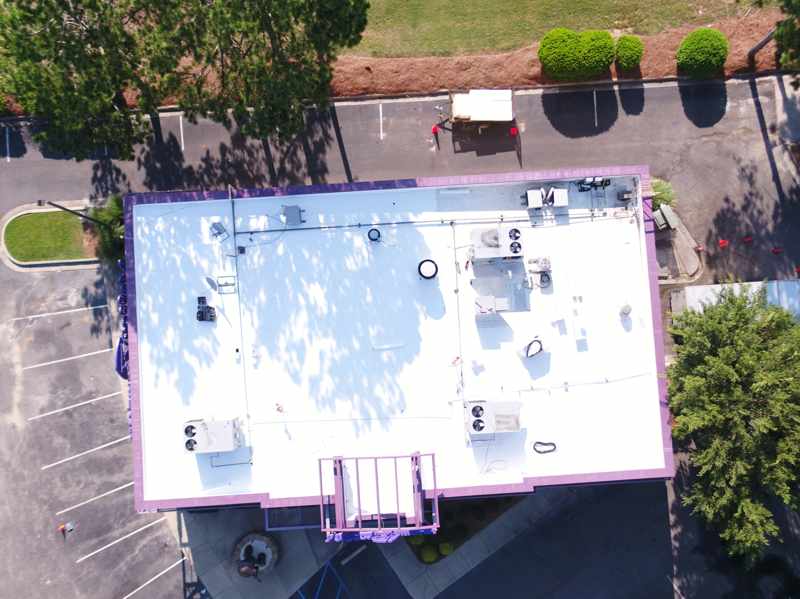
Before Purchasing or Taking Responsibility for a Property
Commercial roofing can represent a significant future liability during the purchase, refinancing or transfer of a property.
A roof may still be functioning while carrying deferred maintenance, trapped moisture, recurring repair areas or a significant capital requirement that is not obvious during a basic property walk-through.
For owners, investors and property-management teams, roof-condition information can therefore form part of broader due diligence.
Depending on the property and transaction, the inspection may help answer questions such as:
What roofing systems are present? How much of the roof appears serviceable? Are there areas requiring immediate investigation? Is a restoration strategy realistic? Is a major replacement likely to enter the capital plan sooner than expected?
Before a Warranty, Lease or Major Capital Decision
There are also times when inspection is useful because a contractual or financial milestone is approaching.
Examples can include an approaching warranty review, lease transition, major mechanical project, planned roof restoration, solar installation, facility expansion or capital-budget cycle.
Documenting roof conditions before that decision can create a clearer record of what was known at the time and where further investigation was recommended.
For facilities teams, this can be particularly useful when roofing decisions must be presented to ownership, finance teams or other stakeholders who were not involved in the original inspection.
Routine Inspection and Preventive Maintenance
Not every inspection should begin with a leak.
Commercial roofs perform better as managed assets when condition information is collected before a failure becomes obvious inside the building.
Routine inspection can help identify developing maintenance issues such as membrane damage, deteriorated repairs, drainage problems, damaged flashings, penetrations requiring attention and other conditions that may be addressed before they contribute to a larger failure.
Infrared or moisture investigation does not necessarily need to be included in every routine visit.
The inspection method should match the building, known roof history and current objective.
A sensible maintenance program can therefore combine regular visual inspection with deeper diagnostic work when the evidence warrants it.
Preventive roof management is not about performing every test every year. It is about knowing when a roof needs a closer look.
Periodic Infrared Inspection for Large or Critical Facilities
Some properties justify more structured diagnostic monitoring because roofing failure has a greater operational consequence.
Healthcare facilities, manufacturing plants, distribution centers, data-sensitive operations and other mission-critical buildings may have a lower tolerance for unexpected water intrusion or extensive emergency work.
Periodic infrared inspection can provide another layer of condition information when incorporated into a broader roof-management program.
Repeated surveys are particularly useful when they are performed consistently enough for the resulting information to be compared over time.
This can help distinguish:
a stable known condition from a developing condition that requires intervention.
That distinction becomes even more valuable at portfolio scale.
Multi-Site and Portfolio Roof Inspections
Property managers and facilities teams responsible for multiple buildings face a different problem from an owner managing a single roof.
The question is no longer simply:
“Does this roof need work?”
It becomes:
“Which roofs need attention first?”
A structured inspection program can help create a consistent condition record across multiple properties.
Over time, that information can be used alongside maintenance history, repair costs, roof age and operational priorities to help organize capital planning.
For a portfolio, the inspection program may support decisions about which roofs should remain under maintenance, which require deeper investigation, which are candidates for restoration and which should begin moving toward replacement planning.
Healthcare Roof Evaluation — Metro Atlanta, Georgia
At a healthcare facility in the Atlanta market, ongoing roof-management work led to additional infrared and moisture investigation when roof conditions warranted a deeper evaluation. The findings helped establish that moisture conditions were more extensive than routine maintenance alone could address, supporting the transition from maintenance planning toward replacement.
This is a useful example of why recurring inspection is not about keeping every roof in a maintenance program indefinitely.
Sometimes the value of monitoring is recognizing when the evidence supports moving to the next capital phase.
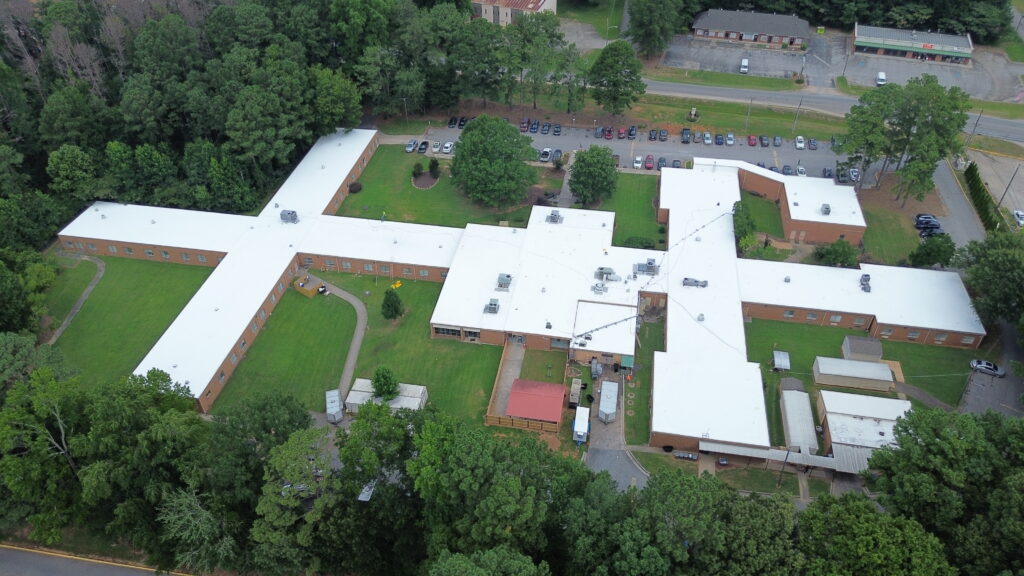
How Often Should a Commercial Roof Be Inspected?
Commercial roofs should generally be inspected on a recurring basis and after events or changes that could materially affect the roofing system.
The appropriate schedule depends on roof age, system type, maintenance history, warranty requirements, building use, previous moisture findings, storm exposure and the operational importance of the facility.
A newer roof with a strong maintenance record may not require the same diagnostic intensity as an aging roof with recurring leaks.
Similarly, a routine visual inspection does not automatically mean that a full infrared and moisture survey should be repeated at the same frequency.
RCRS can help establish an inspection approach based on the building and the decisions the owner needs to make.
Inspection is most valuable when it becomes part of the roof-management cycle rather than an isolated event.
The same inspection technology can serve very different purposes depending on who is responsible for the building. A facility manager may be focused on operational continuity, while a property manager may be comparing multiple roofs, budgets and ownership priorities across an entire portfolio.
Commercial Roof Inspection for Property Managers, Owners & Facility Teams
The same commercial roof inspection can serve very different purposes depending on who is responsible for the building.
A property manager may need consistent documentation across several sites. A building owner may be deciding whether to repair, restore or replace a roof. A facility manager may be focused on preventing disruption to operations and identifying problems before they affect occupied space.
RCRS structures the inspection around the decision that needs to be made rather than treating every client as though they need the same report.
The value of roof-condition data depends on whether it answers the questions the person responsible for the building actually needs to resolve.
For Property Managers
Property managers often need to make roofing decisions across multiple buildings, ownership groups, budgets and maintenance priorities.
A roof inspection can provide documentation that helps property managers understand current conditions without relying solely on service-call history or photographs from individual repairs.
Useful information may include:
- documented roof conditions;
- mapped areas requiring attention;
- recurring problem locations;
- moisture findings where appropriate;
- repair history and previous work;
- recommended follow-up;
- and information that can be retained for future comparison.
For multi-property portfolios, consistency becomes particularly important.
If inspections are documented in a repeatable way, a property manager can begin comparing buildings rather than treating each roof as an isolated problem.
The practical question becomes:
Which properties require attention now, which should remain under maintenance, and which need to enter the capital plan?
For Building Owners
For an owner, the roofing question is often financial as much as technical.
A major roof project can represent a substantial capital expenditure, and the consequences of choosing the wrong scope may continue for years.
Inspection information can help an owner evaluate questions such as:
Can this roof reasonably be repaired?
Is restoration still appropriate?
How much of the roof appears affected?
Is sectional replacement realistic?
Does the evidence support full replacement?
Can capital expenditure be planned rather than treated as an emergency?
This is where the distinction between finding a defect and understanding the condition of the roofing system becomes important.
A leak may justify a repair.
A broader diagnostic investigation may reveal whether that repair is treating an isolated problem or merely postponing a larger capital decision.
For Facility Managers
Facility managers frequently view roofing through the lens of building operations.
Water intrusion may affect production areas, medical spaces, inventory, mechanical systems, tenants, electrical equipment or other parts of the facility where disruption can be expensive.
For that reason, the inspection objective may extend beyond determining whether the membrane is damaged.
Facility teams may need to know:
- where a condition is located;
- whether it appears isolated or widespread;
- whether immediate temporary action is required;
- which areas should be monitored;
- whether maintenance can continue;
- and whether a larger project should be scheduled around operations.
Aerial inspection can also help reduce unnecessary roof access during the initial assessment while allowing physical investigation to be directed toward areas where it is actually needed.
For an operating facility, the best roofing solution is not only technically appropriate. It must also account for what is happening beneath the roof.
Turning Roof Data Into Capital Planning
One of the most important uses of inspection data is determining when money needs to be spent and where.
Without reliable condition information, roofing budgets can become reactive:
leak → repair → another leak → another repair → emergency replacement
A more structured approach can create a different sequence:
inspection → condition assessment → maintenance or repair → monitoring → restoration or replacement planning
That does not eliminate unexpected events.
It provides a better basis for distinguishing routine maintenance from an approaching capital project.
For organizations managing multiple facilities, the same process can help prioritize expenditure between properties.
Repair, Restore or Replace?
Inspection findings can support three very different paths.
Repair
Appropriate where problems are localized and the surrounding roofing system remains serviceable.
Restore
Potentially appropriate where the existing roof remains a viable restoration candidate and unsuitable or moisture-affected areas can be addressed as part of the scope.
Replace
Appropriate where the condition of the roofing system, extent of deterioration, moisture, age or other factors support a larger capital solution.
The inspection does not begin by assuming which of those answers is correct.
The objective is to develop enough information to determine which path is supported by the conditions found.
Good diagnostics should be capable of supporting a smaller scope when appropriate—and a larger scope when the evidence requires it.
Better Documentation for Internal Decision-Making
Roofing decisions are rarely made by one person.
A facility manager may identify the problem.
A property manager may coordinate the investigation.
Ownership may approve the expenditure.
A finance team may need the capital request.
A consultant, manufacturer or insurance representative may later review the documentation.
That makes clear reporting especially valuable.
Mapped findings, photographs, thermal imagery, moisture investigation and verification records can help people who were not present during the inspection understand why a particular recommendation was made.
This can make the conversation much more useful than:
“The roofer says we need a new roof.”
Instead, the recommendation can be tied back to documented observations and the level of verification supporting them.
Building a Roof History Over Time
The value of an inspection record increases when it is retained and compared with future work.
Over time, a property or facility can accumulate:
inspection reports → repair records → thermal surveys → moisture maps → core findings → storm documentation → restoration work → replacement history
That creates a much stronger asset record than a folder containing unrelated invoices and photographs.
For multi-site clients, structured records can eventually support portfolio-level questions involving maintenance spend, recurring problems, roof age and capital planning.
One Inspection Process, Different Business Decisions
Property Manager
Primary question: Which properties need attention, and how should they be prioritized? Inspection value: Consistent documentation, portfolio comparison, owner reporting and budgeting.Building Owner
Primary question: What is the appropriate investment in this roof? Inspection value: Repair/restoration/replacement evidence and capital planning. .Facility Manager
Primary question: How does this roof condition affect building operations? Inspection value: Problem localization, maintenance planning, disruption reduction and operational continuity.RCRS can tailor the inspection scope and reporting to the people who will ultimately use the information.
Managing Multiple Commercial Roofs?
RCRS can help establish a consistent inspection and documentation approach for individual facilities or multi-property portfolios.
What Types of Commercial Roofs Can Be Evaluated With Infrared Thermography?
Infrared thermography can be used on many commercial low-slope roofing systems, but the membrane visible from the surface is only part of the equation.
The reliability of the inspection depends on the complete roof assembly: membrane, insulation, cover board, deck, surfacing, coatings, previous repairs and other materials that influence how heat moves through the roof.
That is why RCRS evaluates the roof construction before deciding which inspection methods are appropriate.
The question is not simply “What type of membrane is on the roof?” It is “How is the entire roof assembly constructed, and will that construction produce information that can be interpreted reliably?”
ASTM C1153-23 specifically addresses nighttime infrared inspection of roofing systems with insulation above the roof deck and in contact with the waterproofing, and recognizes that roof construction, material differences and roof conditions can affect the inspection.
TPO and PVC Single-Ply Roofing
TPO and PVC membranes are common across commercial, industrial, healthcare, retail and institutional facilities.
These roofing systems can often be evaluated using infrared thermography when the underlying assembly and environmental conditions are suitable.
During a properly timed survey, differences in the thermal behavior of the insulation beneath the membrane may produce surface temperature patterns that warrant additional investigation.
However, the membrane alone does not determine whether a thermal pattern represents moisture.
White and highly reflective roofing surfaces can respond differently to solar loading than darker roofs, while membrane repairs, different materials, rooftop equipment and changes in insulation can create additional temperature patterns.
For this reason, RCRS evaluates thermal imagery alongside RGB photographs, known roof construction and physical moisture investigation where appropriate.
Modified Bitumen and Built-Up Roofing
TPO and PVC membranes are common across commercial, industrial, healthcare, retail and institutional facilities.
These roofing systems can often be evaluated using infrared thermography when the underlying assembly and environmental conditions are suitable.
During a properly timed survey, differences in the thermal behavior of the insulation beneath the membrane may produce surface temperature patterns that warrant additional investigation.
However, the membrane alone does not determine whether a thermal pattern represents moisture.
White and highly reflective roofing surfaces can respond differently to solar loading than darker roofs, while membrane repairs, different materials, rooftop equipment and changes in insulation can create additional temperature patterns.
For this reason, RCRS evaluates thermal imagery alongside RGB photographs, known roof construction and physical moisture investigation where appropriate.
EPDM Roofing
EPDM roofing can be evaluated thermographically, but its material characteristics must be considered during interpretation.
Dark EPDM membranes can absorb significant solar energy, creating strong heating and cooling cycles under suitable conditions.
That can be useful for thermography, but temperature differences still need to be evaluated in relation to the roof assembly, surface condition and environmental conditions.
A particularly important distinction arises when electrical-impedance moisture testing is introduced.
Tramex documentation cautions that many black EPDM materials can create false-positive impedance readings because of their dielectric characteristics. Tramex Meters
That does not mean the roof cannot be investigated.
It means the inspection method must change.
A test method that works well on one roof assembly should not automatically be assumed to work the same way on another.
This distinction between thermography and impedance testing is worth making very clear on the page.
Roof Coatings and Restored Roofing Systems
Coated roofs can also be evaluated, particularly when the objective is to understand the condition of the underlying roofing system or establish whether additional moisture investigation is required.
However, the coating itself influences the thermal behavior of the surface.
Highly reflective restoration coatings can reduce solar heat absorption compared with darker roofing materials, which can affect the thermal contrast available during an infrared survey.
Coating thickness, color, previous restoration work and differences between repaired and unrepaired sections may also influence the imagery.
This does not make thermography unusable.
It means the survey conditions and resulting patterns need to be interpreted in the context of the restored roof.
This is especially important when infrared inspection is being used before another coating or restoration project.
The objective is not simply to determine whether the surface looks suitable for coating, but whether conditions within the existing roof support restoration as an appropriate strategy.
Insulation Type Can Change the Thermal Response
Two roofs with the same membrane may behave very differently if the insulation systems beneath them are different.
Commercial roofing assemblies may include materials such as:
- polyisocyanurate insulation
- expanded or extruded polystyrene
- wood-fiber products
- lightweight insulating systems
- gypsum or other cover boards
- and multiple generations of existing roof components.
Different materials absorb, retain and release heat differently.
They can also respond differently when moisture is present.
That is one reason infrared inspection relies on patterns and comparison within the particular roof being surveyed, rather than assuming that a specific temperature automatically represents wet insulation.
ASTM C1153 specifically recognizes the effect of roof construction and material differences on infrared inspection results.
The Roof Deck Matters Too
The deck below the insulation can also influence the inspection.
Commercial buildings may have:
steel decks, concrete decks, wood decks, gypsum systems or other structural assemblies.
Each conducts and stores heat differently.
Building operations beneath the roof can also influence temperature patterns. Mechanical equipment, process heat, conditioned spaces and areas with different interior temperatures may all affect what appears at the roof surface.
This is another reason an aerial thermal pattern cannot be interpreted in isolation.
Where building information is available, RCRS considers the roof and deck construction alongside the imagery and physical observations.
Some Roof Assemblies Require Different Moisture-Testing Methods
Infrared thermography and Tramex impedance testing answer related questions, but they operate on different physical principles.
A roof that can be surveyed thermographically may not necessarily be appropriate for electrical-impedance scanning.
The Tramex DEC uses comparative electrical impedance to identify changes within suitable flat-roof assemblies. Tramex identifies several material conditions that can interfere with readings, including conductive components and aluminum-faced materials. Its documentation also specifically cautions about false-positive responses from many black EPDM membranes. Tramex Meters
For that reason, RCRS considers the construction of the roof before deciding whether DEC scanning is an appropriate verification method.
When one technique is unsuitable, another investigation method may be required.
Metal Roofing Requires Different Interpretation
Metal roof systems deserve separate treatment.
Infrared imagery can still provide useful information about temperature patterns, insulation performance, building-envelope conditions and other features associated with a metal-roofed building.
However, exposed metal surfaces are highly conductive and can also be highly reflective in the infrared spectrum.
Those characteristics mean that a conventional low-slope wet-insulation survey should not automatically be applied to an exposed metal roofing system in the same way it would be applied to a membrane roof over insulation.
Likewise, impedance-based moisture scanning cannot simply be performed through conductive metal as though it were a conventional membrane assembly.
A metal building may therefore require a different combination of visual inspection, thermography, interior investigation or physical testing depending on what the owner is trying to determine.
Ballast, Pavers and Other Surface Coverings Can Limit the View
Some commercial roofs are covered by gravel ballast, pavers, vegetation or other materials above the waterproofing membrane.
Those materials can absorb and release heat independently of the roofing system beneath them.
They may also reduce or alter the thermal signature reaching the exposed surface.
The presence of ballast or another covering does not automatically mean that no diagnostic investigation is possible, but it can materially affect the method and the confidence that should be assigned to the findings.
In these situations, RCRS may recommend a different inspection strategy or additional physical verification.
Why Knowing the Roof Assembly Comes First
Before interpreting thermal or moisture-testing results, the inspection team should understand as much as reasonably possible about how the roof was built.
Useful information can include:
membrane type → insulation type and thickness → cover board → deck construction → number of roof layers → coatings or restoration systems → previous repairs → known moisture history
Original roof drawings, manufacturer records, previous project documents and core samples can all help clarify the assembly when necessary.
This information changes the way inspection data is interpreted.
The technology does not determine whether an inspection method is appropriate. The roof assembly does.
When One Method Is Not Enough
This is another good place to reinforce the overall RCRS methodology.
A roof does not need to fit perfectly into one diagnostic method in order to be investigated.
Depending on the assembly and objective, the process may combine:
visual inspection → RGB aerial documentation → infrared thermography → moisture scanning where suitable → physical investigation → core verification → roofing assessment
The combination should be selected around the building rather than forcing every building through the same test procedure.
FLIR similarly cautions that moisture-related thermal findings should be checked using additional methods because multiple factors can influence how moisture appears thermographically.
Commercial Roof Inspection Method Matrix
| Roof / Condition | Infrared Thermography | Tramex DEC Moisture Scanning | Physical Verification |
|---|---|---|---|
| TPO / PVC membrane roof | Often applicable when conditions and assembly are suitable | Often applicable on suitable assemblies | Used when warranted to confirm findings |
| Modified bitumen / built-up roofing | Often applicable | Depends on assembly, surfacing and underlying materials | Used when warranted |
| EPDM roofing | Often applicable | May produce false-positive responses on many black EPDM systems | Often valuable for correlation and confirmation |
| Coated or restored roof | Can be useful, but reflective coatings may affect thermal response | Depends on the underlying assembly | Used where additional confirmation is needed |
| Exposed metal roof | Requires a different interpretation and inspection approach | Generally unsuitable through conductive metal | Often important when investigating concealed conditions |
| Ballasted, paved or covered roof | May be limited because surface materials can alter the thermal signature | Depends on the complete assembly | May be necessary where surface methods are inconclusive |
| Roof with conductive components or foil-faced materials | May still be useful depending on the assembly | Can interfere with impedance-based testing | May be required to verify conditions |
General inspection considerations — actual suitability depends on the complete roof assembly and inspection objective.
Because every roofing system responds differently, a professional inspection should begin by defining both the roof assembly and the question the inspection needs to answer. From there, the appropriate combination of aerial imaging, thermography, moisture investigation and physical verification can be selected.
Asked Question
Frequently
Asked Questions
Here, you can find answers to some of the most common questions we receive about our drone restoration commercial roofing services. If you have a question that is not answered here, please feel free to contact us.
-
Q.Can an infrared camera see water through a commercial roof?
The camera records differences in thermal energy at the roof surface. Under suitable conditions, roofing materials containing moisture may heat and cool differently from surrounding dry materials, producing temperature patterns that warrant further investigation. Those patterns must be interpreted in the context of the roof assembly, environmental conditions, visible imagery and—where appropriate—physical moisture testing.
-
Q.Does a thermal anomaly mean there is wet insulation?
Not necessarily. A thermal anomaly simply means that an area is behaving differently from its surroundings. Reflected heat, different roofing materials, repairs, drainage conditions, rooftop equipment, insulation changes and environmental effects can all create temperature differences. RCRS treats a thermal anomaly as a reason to investigate, not automatic confirmation of moisture.
-
Q.How are infrared roof inspection findings verified?
Where a thermal finding warrants further investigation, RCRS can correlate it with high-resolution RGB imagery and targeted on-roof moisture testing. This may include Tramex DEC non-destructive moisture investigation, comparative readings, moisture mapping and, when appropriate and authorized, physical core sampling. The objective is to build multiple layers of evidence rather than relying on a thermal image alone.
-
Q.Can infrared inspection find the exact location of a roof leak?
Infrared inspection can help identify areas where conditions within the roofing system may require further investigation, but it does not necessarily identify the exact point where water entered the roof. Water can travel within a roofing assembly before becoming visible. Determining the source of leakage may require visual inspection, moisture investigation, examination of penetrations and flashings, and other physical diagnostic work.
-
Q.Why are infrared roof inspections often performed at night?
After sunset, roofing materials begin releasing heat absorbed during the day. Under suitable conditions, wet and dry components may cool at different rates, creating thermal contrast that can be evaluated at the roof surface. RCRS nighttime surveys are commonly performed approximately two to four hours after sunset, although the appropriate inspection window depends on the roof assembly, weather and thermal behavior of the building.
-
Q.How accurate is a drone infrared roof inspection?
The reliability of the inspection depends on much more than the drone or thermal camera. Important factors include thermal resolution, radiometric capability, optics, flight methodology, weather, solar loading, roof construction, survey timing, operator training, interpretation and physical verification. A high-quality thermal image can provide valuable diagnostic information, but no inspection method should be treated as infallible or interpreted without context.
-
Q.What types of commercial roofs can be inspected with infrared thermography?
Many low-slope commercial roofing systems can be evaluated thermographically when the complete roof assembly and environmental conditions are suitable. These can include TPO, PVC, EPDM, modified bitumen, built-up roofing and some coated or restored systems. However, membrane type is only one factor. Insulation, cover boards, deck construction, surface materials, ballast, coatings and conductive components can all influence which inspection methods are appropriate.
-
Q.Does a drone inspection eliminate the need to walk the roof?
Not always. Drone inspection can reduce unnecessary roof access by documenting large areas remotely and helping identify locations that deserve closer attention. However, physical roof access may still be required for moisture testing, core verification, detailed membrane examination, repairs or other diagnostic work. A common approach is: aerial inspection → identify areas of concern → targeted roof access → physical investigation where necessary
-
Q.What is included in a commercial drone and infrared roof inspection report?
The exact deliverables depend on the project, but a professional report may include high-resolution RGB imagery, infrared images, mapped findings, areas requiring further investigation, moisture-testing results, core locations, field observations, limitations and recommended next steps. The goal is to create a record that can support maintenance, repair, restoration, replacement and capital-planning decisions.
-
Q.How much does a commercial drone and infrared roof inspection cost?
Pricing depends on the size and number of buildings, inspection objective, required imagery, thermal survey scope, moisture testing, reporting requirements, travel and site conditions. A basic aerial documentation flight and a comprehensive infrared/moisture investigation are fundamentally different services. RCRS scopes the inspection around the information required rather than applying one flat price to every commercial roof.
-
Q.Are commercial drone roof inspections allowed near airports?
They can be, depending on the airspace and the specific operation. Some locations require FAA airspace authorization, while others may be operated in without prior air-traffic-control authorization under applicable Part 107 rules. Properties near airports therefore require airspace review as part of the inspection planning process.
-
Q.Can infrared inspection help determine whether a roof should be repaired, restored or replaced?
It can provide important evidence for that decision, especially when combined with visual inspection, moisture investigation and physical verification. Infrared inspection does not automatically determine the correct roofing scope. Instead, it helps establish what conditions may exist within the roof so those findings can be considered alongside membrane condition, roof age, repair history, building requirements and other factors. The objective is not to produce a thermal image. It is to develop enough reliable information to make a better roofing decision. I’d probably use 10–12 of these visibly in an accordion, rather than all 16, and keep the remainder for the supporting drone pages. For this flagship, the strongest ones are the questions about seeing water, thermal anomalies, verification, leak location, nighttime surveys, accuracy, roof types, roof access, reports, cost, airports, and repair/restore/replace.
-
Q.Can RCRS Perform an Inspection Without Doing the Roofing Work?
Yes. RCRS accepts inspection-only engagements where the objective is to document roof conditions, investigate moisture, provide diagnostic information or support another professional’s evaluation. The resulting information can be used by the building owner, property manager, consultant, engineer or other roofing contractor as appropriate to the project. RCRS can also provide inspection and diagnostic services as part of a broader roofing project when the client wants one team to carry the findings through into repair, restoration or replacement.
-
Q.Can You Use a Drone to Inspect Asphalt-Shingle and Steep-Slope Roofs?
Yes. Although RCRS's infrared moisture-investigation methodology is particularly valuable on insulated commercial low-slope roofing systems, drone inspection is also useful for asphalt-shingle and other steep-slope roofs. High-resolution aerial imagery can document shingles, ridges, penetrations, flashing, drainage conditions and difficult-to-access roof areas on apartment buildings, multifamily properties, churches and other commercial facilities. The appropriate inspection method depends on the roof assembly and the question the owner or property manager needs answered.
Need to Understand What’s Happening on Your Commercial Roof?
RCRS can help determine the appropriate inspection scope based on the property, roofing system and decision you need to make.
Request a Commercial Roof Inspection
Tell us the property location, approximate roof size and what you’re trying to determine. We can recommend the appropriate combination of aerial imaging, infrared thermography, moisture investigation and physical verification.


Testimonials
What our clients are saying

I contacted this company about emergency maintenace issues located at one of my Zaxby's restaurant locations. I received a quick response from this company and great work.
Nick Carter
Restoration Commercial Roofing Services
I was very satisfied with the work they did. The process was fast and efficient. I would definitely recommend them!
Mike Lane
Restoration Commercial Roofing Services
Very satisfied! everything was done in a timely manner and very professional! Highly recommend! I have recommended them to several people!! Excellent company!!
Karla & Charles
Restoration Commercial Roofing Services
We were very satisfied, crew was very respectful. Would use them again for sure! And definitely refer them to others!! we were very happy!!!
John & Lorainne Mouery
Restoration Commercial Roofing Services
Very Satisfied, the work and crew were very fast, friendly and efficient
Karen Willis
Restoration Commercial Roofing ServicesReady to Protect Your Roof?
Don’t wait for costly damage to occur—enhance your roof’s longevity with our professional coating services. Contact Restoration Commercial Roofing Services today to schedule a consultation and discover the best coating solution for your commercial property.
Call us Toll Free on: (888) 707-1916, email us at info@restorationcommercialroofing.com, or fill out our online contact form.


Our Clients